Custom agent template workflows
Custom agents and agent-based workflows allow you to define arbitrary
orchestration logic by inheriting directly from BaseAgent and implementing
your own control flow. This approach allows you to create new execution patterns
similar to SequentialAgent, LoopAgent, and ParallelAgent, enabling you to
build highly specific and complex agentic workflows.
Alternative: graph-based workflows
Starting in ADK 2.0, agent-based workflows using
BaseAgent have been superseded
by more flexible workflow structures, including graph-based workflows and dynamic workflows. You should evaluate the capabilities of these workflow mechanisms before building a custom agent for your target workflow.
Advanced Concept
Building custom agents by directly implementing _run_async_impl, or its
equivalent in other languages, provides powerful control but is more complex
than using the predefined LlmAgent or WorkflowAgent types. We
recommend understanding those foundational agent types first before tackling
custom orchestration logic.
Overview
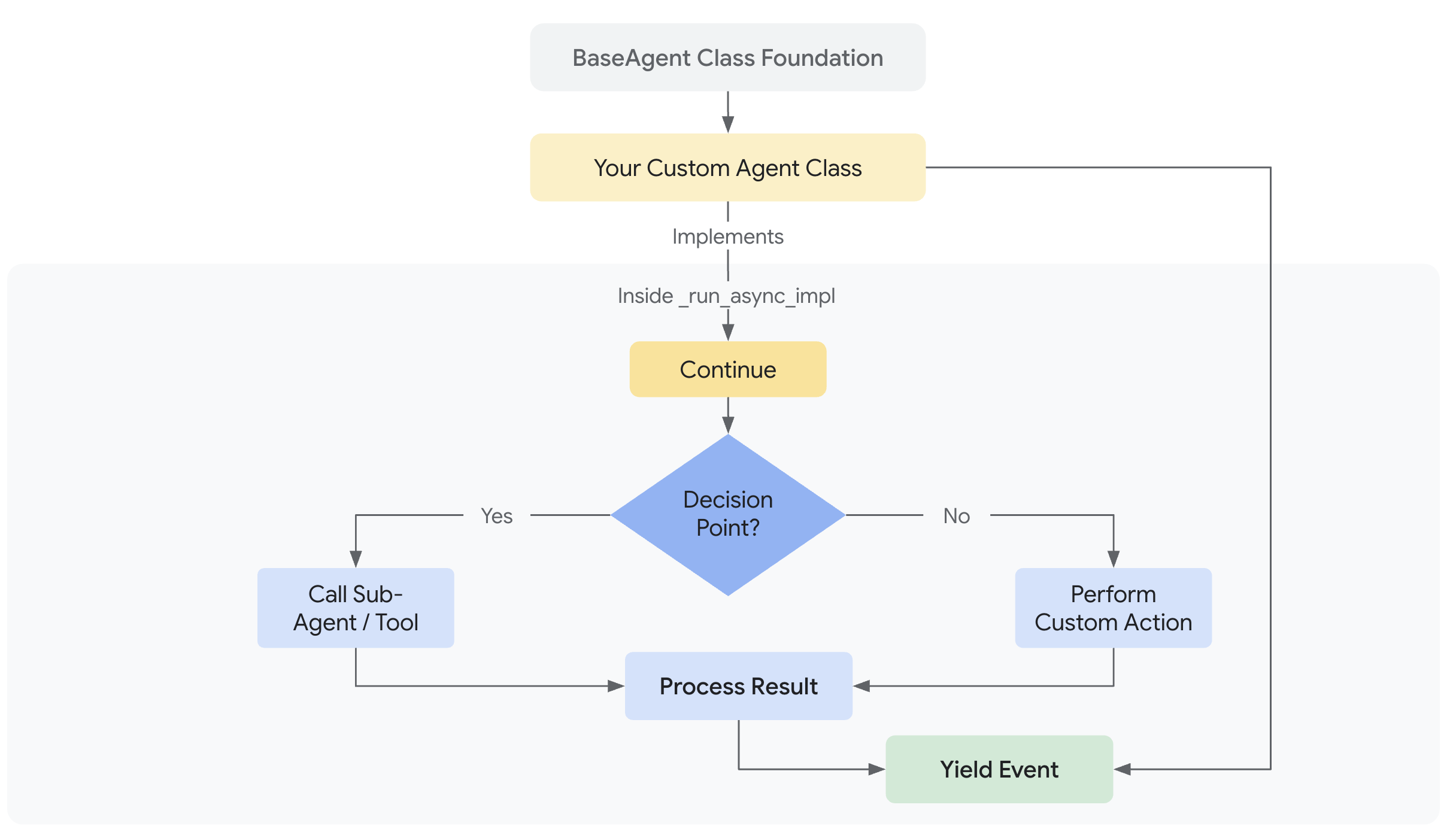
A Custom Agent is essentially any class you create that inherits from
google.adk.agents.BaseAgent and implements its core execution logic within the
_run_async_impl asynchronous method. You have complete control over how this
method calls other sub-agents, manages state, and handles events.
Note
The specific method name for implementing an agent's core asynchronous logic may
vary slightly by SDK language, such as runAsyncImpl in Java, _run_async_impl
in Python, or runAsyncImpl in TypeScript. Refer to the language-specific API
documentation for details.
Why build Custom Agents?
After reviewing exising ADK agent workflow approaches and architectures, you may want to consider building a custom workflow agent if those mechanisms cannot meet one or more of following requirements for your project:
- Conditional Logic: Executing different sub-agents or taking different paths based on runtime conditions or the results of previous steps.
- Complex State Management: Implementing intricate logic for maintaining and updating state throughout the workflow beyond simple sequential passing.
- External Integrations: Incorporating calls to external APIs, databases, or custom libraries directly within the orchestration flow control.
- Dynamic Agent Selection: Choosing which sub-agent(s) to run next based on dynamic evaluation of the situation or input.
- Unique Workflow Patterns: Implementing orchestration logic that doesn't fit the standard sequential, parallel, or loop structures.
Implementing custom logic
The core of any custom agent is the method where you define its unique asynchronous behavior. This method allows you to orchestrate sub-agents and manage the flow of execution.
The heart of any custom agent is the _run_async_impl method. This is where you define its unique behavior.
- Signature:
async def _run_async_impl(self, ctx: InvocationContext) -> AsyncGenerator[Event, None]: - Asynchronous Generator: It must be an
async deffunction and return anAsyncGenerator. This allows it toyieldevents produced by sub-agents or its own logic back to the runner. ctx(InvocationContext): Provides access to crucial runtime information, most importantlyctx.session.state, which is the primary way to share data between steps orchestrated by your custom agent.
The heart of any custom agent is the runAsyncImpl method. This is where you define its unique behavior.
- Signature:
async* runAsyncImpl(ctx: InvocationContext): AsyncGenerator<Event, void, undefined> - Asynchronous Generator: It must be an
asyncgenerator function (async*). ctx(InvocationContext): Provides access to crucial runtime information, most importantlyctx.session.state, which is the primary way to share data between steps orchestrated by your custom agent.
In Go, you implement the Run method as part of a struct that satisfies the agent.Agent interface. The actual logic is typically a method on your custom agent struct.
- Signature:
Run(ctx agent.InvocationContext) iter.Seq2[*session.Event, error] - Iterator: The
Runmethod returns an iterator (iter.Seq2) that yields events and errors. This is the standard way to handle streaming results from an agent's execution. ctx(InvocationContext): Theagent.InvocationContextprovides access to the session, including state, and other crucial runtime information.- Session State: You can access the session state through
ctx.Session().State().
The heart of any custom agent is the runAsyncImpl method, which you override from BaseAgent.
- Signature:
protected Flowable<Event> runAsyncImpl(InvocationContext ctx) - Reactive Stream (
Flowable): It must return anio.reactivex.rxjava3.core.Flowable<Event>. ThisFlowablerepresents a stream of events that will be produced by the custom agent's logic, often by combining or transforming multipleFlowablefrom sub-agents. ctx(InvocationContext): Provides access to crucial runtime information, most importantlyctx.session().state(), which is ajava.util.concurrent.ConcurrentMap<String, Object>. This is the primary way to share data between steps orchestrated by your custom agent.
Key capabilities within the core asynchronous method
-
Calling Sub-Agents: You invoke sub-agents (which are typically stored as instance attributes like
self.my_llm_agent) using theirrun_asyncmethod and yield their events: -
Managing State: Read from and write to the session state dictionary (
ctx.session.state) to pass data between sub-agent calls or make decisions:# Read data set by a previous agent previous_result = ctx.session.state.get("some_key") # Make a decision based on state if previous_result == "some_value": # ... call a specific sub-agent ... else: # ... call another sub-agent ... # Store a result for a later step (often done via a sub-agent's output_key) # ctx.session.state["my_custom_result"] = "calculated_value" -
Implementing Control Flow: Use standard Python constructs (
if/elif/else,for/whileloops,try/except) to create sophisticated, conditional, or iterative workflows involving your sub-agents.
-
Calling Sub-Agents: You invoke sub-agents (which are typically stored as instance properties like
this.myLlmAgent) using theirrunmethod and yield their events: -
Managing State: Read from and write to the session state object (
ctx.session.state) to pass data between sub-agent calls or make decisions:// Read data set by a previous agent const previousResult = ctx.session.state['some_key']; // Make a decision based on state if (previousResult === 'some_value') { // ... call a specific sub-agent ... } else { // ... call another sub-agent ... } // Store a result for a later step (often done via a sub-agent's outputKey) // ctx.session.state['my_custom_result'] = 'calculated_value'; -
Implementing Control Flow: Use standard TypeScript/JavaScript constructs (
if/else,for/whileloops,try/catch) to create sophisticated, conditional, or iterative workflows involving your sub-agents.
-
Calling Sub-Agents: You invoke sub-agents by calling their
Runmethod. -
Managing State: Read from and write to the session state to pass data between sub-agent calls or make decisions.
// The `ctx` (`agent.InvocationContext`) is passed directly to your agent's `Run` function. // Read data set by a previous agent previousResult, err := ctx.Session().State().Get("some_key") if err != nil { // Handle cases where the key might not exist yet } // Make a decision based on state if val, ok := previousResult.(string); ok && val == "some_value" { // ... call a specific sub-agent ... } else { // ... call another sub-agent ... } // Store a result for a later step if err := ctx.Session().State().Set("my_custom_result", "calculated_value"); err != nil { // Handle error } -
Implementing Control Flow: Use standard Go constructs (
if/else,for/switchloops, goroutines, channels) to create sophisticated, conditional, or iterative workflows involving your sub-agents.
-
Calling Sub-Agents: You invoke sub-agents (which are typically stored as instance attributes or objects) using their asynchronous run method and return their event streams:
You typically chain
Flowables from sub-agents using RxJava operators likeconcatWith,flatMapPublisher, orconcatArray.The// Example: Running one sub-agent // return someSubAgent.runAsync(ctx); // Example: Running sub-agents sequentially Flowable<Event> firstAgentEvents = someSubAgent1.runAsync(ctx) .doOnNext(event -> System.out.println("Event from agent 1: " + event.id())); Flowable<Event> secondAgentEvents = Flowable.defer(() -> someSubAgent2.runAsync(ctx) .doOnNext(event -> System.out.println("Event from agent 2: " + event.id())) ); return firstAgentEvents.concatWith(secondAgentEvents);Flowable.defer()is often used for subsequent stages if their execution depends on the completion or state after prior stages. -
Managing State: Read from and write to the session state to pass data between sub-agent calls or make decisions. The session state is a
java.util.concurrent.ConcurrentMap<String, Object>obtained viactx.session().state().// Read data set by a previous agent Object previousResult = ctx.session().state().get("some_key"); // Make a decision based on state if ("some_value".equals(previousResult)) { // ... logic to include a specific sub-agent's Flowable ... } else { // ... logic to include another sub-agent's Flowable ... } // Store a result for a later step (often done via a sub-agent's output_key) // ctx.session().state().put("my_custom_result", "calculated_value"); -
Implementing Control Flow: Use standard language constructs (
if/else, loops,try/catch) combined with reactive operators (RxJava) to create sophisticated workflows.- Conditional:
Flowable.defer()to choose whichFlowableto subscribe to based on a condition, orfilter()if you're filtering events within a stream. - Iterative: Operators like
repeat(),retry(), or by structuring yourFlowablechain to recursively call parts of itself based on conditions (often managed withflatMapPublisherorconcatMap).
- Conditional:
Managing sub-agents and state
Typically, a custom agent orchestrates other agents (like LlmAgent, LoopAgent, etc.).
- Initialization: You usually pass instances of these sub-agents into your custom agent's constructor and store them as instance fields/attributes (e.g.,
this.story_generator = story_generator_instanceorself.story_generator = story_generator_instance). This makes them accessible within the custom agent's core asynchronous execution logic (such as:_run_async_implmethod). - Sub Agents List: When initializing the
BaseAgentusing it'ssuper()constructor, you should pass asub agentslist. This list tells the ADK framework about the agents that are part of this custom agent's immediate hierarchy. It's important for framework features like lifecycle management, introspection, and potentially future routing capabilities, even if your core execution logic (_run_async_impl) calls the agents directly viaself.xxx_agent. Include the agents that your custom logic directly invokes at the top level. - State: As mentioned,
ctx.session.stateis the standard way sub-agents (especiallyLlmAgents usingoutput key) communicate results back to the orchestrator and how the orchestrator passes necessary inputs down.
Agent-based workflow primitives
The following sections detail the core ADK primitives—such as agent hierarchy, workflow agents, and interaction mechanisms—that enable you to construct and manage these multi-agent systems effectively. ADK provides core building blocks—primitives—that enable you to structure and manage interactions within your multi-agent system.
Note
The specific parameters or method names for the primitives may vary slightly by
SDK language, for example sub_agents in Python, and subAgents in Java. Refer
to the language-specific API documentation for details.
Agent hierarchy: Parent agents and sub-agents
The foundation for structuring multi-agent systems is the parent-child relationship defined in BaseAgent.
- Establishing Hierarchy: You create a tree structure by passing a list of agent instances to the
sub_agentsargument when initializing a parent agent. ADK automatically sets theparent_agentattribute on each child agent during initialization. - Single Parent Rule: An agent instance can only be added as a sub-agent once. Attempting to assign a second parent will result in a
ValueError. - Importance: This hierarchy defines the scope for Workflow Agents and influences the potential targets for LLM-Driven Delegation. You can navigate the hierarchy using
agent.parent_agentor find descendants usingagent.find_agent(name).
# Conceptual Example: Defining Hierarchy
from google.adk.agents import LlmAgent, BaseAgent


# Define individual agents
greeter = LlmAgent(name="Greeter", model="gemini-flash-latest")
task_doer = BaseAgent(name="TaskExecutor") # Custom non-LLM agent


# Create parent agent and assign children via sub_agents
coordinator = LlmAgent(
    name="Coordinator",
    model="gemini-flash-latest",
    description="I coordinate greetings and tasks.",
    sub_agents=[ # Assign sub_agents here
        greeter,
        task_doer
    ]
)


# Framework automatically sets:
# assert greeter.parent_agent == coordinator
# assert task_doer.parent_agent == coordinator
// Conceptual Example: Defining Hierarchy
import { LlmAgent, BaseAgent, InvocationContext } from '@google/adk';
import type { Event, createEventActions } from '@google/adk';

class TaskExecutorAgent extends BaseAgent {
  async *runAsyncImpl(context: InvocationContext): AsyncGenerator<Event, void, void> {
    yield {
      id: 'event-1',
      invocationId: context.invocationId,
      author: this.name,
      content: { parts: [{ text: 'Task completed!' }] },
      actions: createEventActions(),
      timestamp: Date.now(),
    };
  }
  async *runLiveImpl(context: InvocationContext): AsyncGenerator<Event, void, void> {
    this.runAsyncImpl(context);
  }
}

// Define individual agents
const greeter = new LlmAgent({name: 'Greeter', model: 'gemini-flash-latest'});
const taskDoer = new TaskExecutorAgent({name: 'TaskExecutor'}); // Custom non-LLM agent

// Create parent agent and assign children via subAgents
const coordinator = new LlmAgent({
    name: 'Coordinator',
    model: 'gemini-flash-latest',
    description: 'I coordinate greetings and tasks.',
    subAgents: [ // Assign subAgents here
        greeter,
        taskDoer
    ],
});

// Framework automatically sets:
// console.assert(greeter.parentAgent === coordinator);
// console.assert(taskDoer.parentAgent === coordinator);
import (
    "google.golang.org/adk/agent"
    "google.golang.org/adk/agent/llmagent"
)

// Conceptual Example: Defining Hierarchy
// Define individual agents
greeter, _ := llmagent.New(llmagent.Config{Name: "Greeter", Model: m})
taskDoer, _ := agent.New(agent.Config{Name: "TaskExecutor"}) // Custom non-LLM agent

// Create parent agent and assign children via sub_agents
coordinator, _ := llmagent.New(llmagent.Config{
    Name:        "Coordinator",
    Model:       m,
    Description: "I coordinate greetings and tasks.",
    SubAgents:   []agent.Agent{greeter, taskDoer}, // Assign sub_agents here
})
// Conceptual Example: Defining Hierarchy
import com.google.adk.agents.SequentialAgent;
import com.google.adk.agents.LlmAgent;


// Define individual agents
LlmAgent greeter = LlmAgent.builder().name("Greeter").model("gemini-flash-latest").build();
SequentialAgent taskDoer = SequentialAgent.builder().name("TaskExecutor").subAgents(...).build(); // Sequential Agent


// Create parent agent and assign sub_agents
LlmAgent coordinator = LlmAgent.builder()
    .name("Coordinator")
    .model("gemini-flash-latest")
    .description("I coordinate greetings and tasks")
    .subAgents(greeter, taskDoer) // Assign sub_agents here
    .build();


// Framework automatically sets:
// assert greeter.parentAgent().equals(coordinator);
// assert taskDoer.parentAgent().equals(coordinator);
class TaskExecutorAgent : BaseAgent(name = "TaskExecutor") {
    override fun runAsyncImpl(context: InvocationContext): Flow<Event> {
        return flowOf(
            Event(
                author = name,
                content = Content(parts = listOf(Part(text = "Task completed!"))),
            ),
        )
    }
}
val greeter = LlmAgent(name = "Greeter", model = model)
val taskDoer = TaskExecutorAgent()

val coordinator =
    LlmAgent(
        name = "Coordinator",
        model = model,
        description = "I coordinate greetings and tasks.",
        subAgents = listOf(greeter, taskDoer),
    )
Workflow agents as orchestrators
ADK includes specialized agents derived from BaseAgent that don't perform tasks themselves but orchestrate the execution flow of their sub_agents.
SequentialAgent: Executes itssub_agentsone after another in the order they are listed.- Context: Passes the same
InvocationContextsequentially, allowing agents to easily pass results via shared state.
- Context: Passes the same
# Conceptual Example: Sequential Pipeline
from google.adk.agents import SequentialAgent, LlmAgent

step1 = LlmAgent(name="Step1_Fetch", output_key="data") # Saves output to state['data']
step2 = LlmAgent(name="Step2_Process", instruction="Process data from {data}.")

pipeline = SequentialAgent(name="MyPipeline", sub_agents=[step1, step2])
# When pipeline runs, Step2 can access the state['data'] set by Step1.
// Conceptual Example: Sequential Pipeline
import { SequentialAgent, LlmAgent } from '@google/adk';

const step1 = new LlmAgent({name: 'Step1_Fetch', outputKey: 'data'}); // Saves output to state['data']
const step2 = new LlmAgent({name: 'Step2_Process', instruction: 'Process data from {data}.'});

const pipeline = new SequentialAgent({name: 'MyPipeline', subAgents: [step1, step2]});
// When pipeline runs, Step2 can access the state['data'] set by Step1.
import (
    "google.golang.org/adk/agent"
    "google.golang.org/adk/agent/llmagent"
    "google.golang.org/adk/agent/workflowagents/sequentialagent"
)

// Conceptual Example: Sequential Pipeline
step1, _ := llmagent.New(llmagent.Config{Name: "Step1_Fetch", OutputKey: "data", Model: m}) // Saves output to state["data"]
step2, _ := llmagent.New(llmagent.Config{Name: "Step2_Process", Instruction: "Process data from {data}.", Model: m})

pipeline, _ := sequentialagent.New(sequentialagent.Config{
    AgentConfig: agent.Config{Name: "MyPipeline", SubAgents: []agent.Agent{step1, step2}},
})
// When pipeline runs, Step2 can access the state["data"] set by Step1.
// Conceptual Example: Sequential Pipeline
import com.google.adk.agents.SequentialAgent;
import com.google.adk.agents.LlmAgent;

LlmAgent step1 = LlmAgent.builder().name("Step1_Fetch").outputKey("data").build(); // Saves output to state.get("data")
LlmAgent step2 = LlmAgent.builder().name("Step2_Process").instruction("Process data from {data}.").build();

SequentialAgent pipeline = SequentialAgent.builder().name("MyPipeline").subAgents(step1, step2).build();
// When pipeline runs, Step2 can access the state.get("data") set by Step1.
ParallelAgent: Executes itssub_agentsin parallel. Events from sub-agents may be interleaved.- Context: Modifies the
InvocationContext.branchfor each child agent (e.g.,ParentBranch.ChildName), providing a distinct contextual path which can be useful for isolating history in some memory implementations. - State: Despite different branches, all parallel children access the same shared
session.state, enabling them to read initial state and write results (use distinct keys to avoid race conditions).
- Context: Modifies the
# Conceptual Example: Parallel Execution
from google.adk.agents import ParallelAgent, LlmAgent

fetch_weather = LlmAgent(name="WeatherFetcher", output_key="weather")
fetch_news = LlmAgent(name="NewsFetcher", output_key="news")

gatherer = ParallelAgent(name="InfoGatherer", sub_agents=[fetch_weather, fetch_news])
# When gatherer runs, WeatherFetcher and NewsFetcher run concurrently.
# A subsequent agent could read state['weather'] and state['news'].
// Conceptual Example: Parallel Execution
import { ParallelAgent, LlmAgent } from '@google/adk';

const fetchWeather = new LlmAgent({name: 'WeatherFetcher', outputKey: 'weather'});
const fetchNews = new LlmAgent({name: 'NewsFetcher', outputKey: 'news'});

const gatherer = new ParallelAgent({name: 'InfoGatherer', subAgents: [fetchWeather, fetchNews]});
// When gatherer runs, WeatherFetcher and NewsFetcher run concurrently.
// A subsequent agent could read state['weather'] and state['news'].
import (
    "google.golang.org/adk/agent"
    "google.golang.org/adk/agent/llmagent"
    "google.golang.org/adk/agent/workflowagents/parallelagent"
)

// Conceptual Example: Parallel Execution
fetchWeather, _ := llmagent.New(llmagent.Config{Name: "WeatherFetcher", OutputKey: "weather", Model: m})
fetchNews, _ := llmagent.New(llmagent.Config{Name: "NewsFetcher", OutputKey: "news", Model: m})

gatherer, _ := parallelagent.New(parallelagent.Config{
    AgentConfig: agent.Config{Name: "InfoGatherer", SubAgents: []agent.Agent{fetchWeather, fetchNews}},
})
// When gatherer runs, WeatherFetcher and NewsFetcher run concurrently.
// A subsequent agent could read state["weather"] and state["news"].
// Conceptual Example: Parallel Execution
import com.google.adk.agents.LlmAgent;
import com.google.adk.agents.ParallelAgent;


LlmAgent fetchWeather = LlmAgent.builder()
    .name("WeatherFetcher")
    .outputKey("weather")
    .build();


LlmAgent fetchNews = LlmAgent.builder()
    .name("NewsFetcher")
    .instruction("news")
    .build();


ParallelAgent gatherer = ParallelAgent.builder()
    .name("InfoGatherer")
    .subAgents(fetchWeather, fetchNews)
    .build();


// When gatherer runs, WeatherFetcher and NewsFetcher run concurrently.
// A subsequent agent could read state['weather'] and state['news'].
LoopAgent: Executes itssub_agentssequentially in a loop.- Termination: The loop stops if the optional
max_iterationsis reached, or if any sub-agent returns anEventwithescalate=Truein its Event Actions. - Context & State: Passes the same
InvocationContextin each iteration, allowing state changes (e.g., counters, flags) to persist across loops.
- Termination: The loop stops if the optional
# Conceptual Example: Loop with Condition
from google.adk.agents import LoopAgent, LlmAgent, BaseAgent
from google.adk.events import Event, EventActions
from google.adk.agents.invocation_context import InvocationContext
from typing import AsyncGenerator

class CheckCondition(BaseAgent): # Custom agent to check state
    async def _run_async_impl(self, ctx: InvocationContext) -> AsyncGenerator[Event, None]:
        status = ctx.session.state.get("status", "pending")
        is_done = (status == "completed")
        yield Event(author=self.name, actions=EventActions(escalate=is_done)) # Escalate if done

process_step = LlmAgent(name="ProcessingStep") # Agent that might update state['status']

poller = LoopAgent(
    name="StatusPoller",
    max_iterations=10,
    sub_agents=[process_step, CheckCondition(name="Checker")]
)
# When poller runs, it executes process_step then Checker repeatedly
# until Checker escalates (state['status'] == 'completed') or 10 iterations pass.
// Conceptual Example: Loop with Condition
import { LoopAgent, LlmAgent, BaseAgent, InvocationContext } from '@google/adk';
import type { Event, createEventActions, EventActions } from '@google/adk';

class CheckConditionAgent extends BaseAgent { // Custom agent to check state
    async *runAsyncImpl(ctx: InvocationContext): AsyncGenerator<Event> {
        const status = ctx.session.state['status'] || 'pending';
        const isDone = status === 'completed';
        yield createEvent({ author: 'check_condition', actions: createEventActions({ escalate: isDone }) });
    }

    async *runLiveImpl(ctx: InvocationContext): AsyncGenerator<Event> {
        // This is not implemented.
    }
};

const processStep = new LlmAgent({name: 'ProcessingStep'}); // Agent that might update state['status']

const poller = new LoopAgent({
    name: 'StatusPoller',
    maxIterations: 10,
    // Executes its sub_agents sequentially in a loop
    subAgents: [processStep, new CheckConditionAgent ({name: 'Checker'})]
});
// When poller runs, it executes processStep then Checker repeatedly
// until Checker escalates (state['status'] === 'completed') or 10 iterations pass.
import (
    "iter"
    "google.golang.org/adk/agent"
    "google.golang.org/adk/agent/llmagent"
    "google.golang.org/adk/agent/workflowagents/loopagent"
    "google.golang.org/adk/session"
)

// Conceptual Example: Loop with Condition
// Custom agent to check state
checkCondition, _ := agent.New(agent.Config{
    Name: "Checker",
    Run: func(ctx agent.InvocationContext) iter.Seq2[*session.Event, error] {
        return func(yield func(*session.Event, error) bool) {
            status, err := ctx.Session().State().Get("status")
            // If "status" is not in the state, default to "pending".
            // This is idiomatic Go for handling a potential error on lookup.
            if err != nil {
                status = "pending"
            }
            isDone := status == "completed"
            yield(&session.Event{Author: "Checker", Actions: session.EventActions{Escalate: isDone}}, nil)
        }
    },
})

processStep, _ := llmagent.New(llmagent.Config{Name: "ProcessingStep", Model: m}) // Agent that might update state["status"]

poller, _ := loopagent.New(loopagent.Config{
    MaxIterations: 10,
    AgentConfig:   agent.Config{Name: "StatusPoller", SubAgents: []agent.Agent{processStep, checkCondition}},
})
// When poller runs, it executes processStep then Checker repeatedly
// until Checker escalates (state["status"] == "completed") or 10 iterations pass.
// Conceptual Example: Loop with Condition
// Custom agent to check state and potentially escalate
public static class CheckConditionAgent extends BaseAgent {
  public CheckConditionAgent(String name, String description) {
    super(name, description, List.of(), null, null);
  }

  @Override
  protected Flowable<Event> runAsyncImpl(InvocationContext ctx) {
    String status = (String) ctx.session().state().getOrDefault("status", "pending");
    boolean isDone = "completed".equalsIgnoreCase(status);

    // Emit an event that signals to escalate (exit the loop) if the condition is met.
    // If not done, the escalate flag will be false or absent, and the loop continues.
    Event checkEvent = Event.builder()
            .author(name())
            .id(Event.generateEventId()) // Important to give events unique IDs
            .actions(EventActions.builder().escalate(isDone).build()) // Escalate if done
            .build();
    return Flowable.just(checkEvent);
  }
}

// Agent that might update state.put("status")
LlmAgent processingStepAgent = LlmAgent.builder().name("ProcessingStep").build();
// Custom agent instance for checking the condition
CheckConditionAgent conditionCheckerAgent = new CheckConditionAgent(
    "ConditionChecker",
    "Checks if the status is 'completed'."
);
LoopAgent poller = LoopAgent.builder().name("StatusPoller").maxIterations(10).subAgents(processingStepAgent, conditionCheckerAgent).build();
// When poller runs, it executes processingStepAgent then conditionCheckerAgent repeatedly
// until Checker escalates (state.get("status") == "completed") or 10 iterations pass.
class CheckConditionAgent(name: String) : BaseAgent(name = name) {
    override fun runAsyncImpl(context: InvocationContext): Flow<Event> {
        val status = context.session.state["status"] as? String ?: "pending"
        val isDone = status == "completed"
        return flowOf(
            Event(
                author = name,
                actions = EventActions(escalate = isDone),
            ),
        )
    }
}
val processStep = LlmAgent(name = "ProcessingStep", model = model)
val checker = CheckConditionAgent(name = "Checker")

val poller =
    LoopAgent(
        name = "StatusPoller",
        maxIterations = 10,
        subAgents = listOf(processStep, checker),
    )
Interaction and communication mechanisms
Agents within a system often need to exchange data or trigger actions in one another. ADK facilitates this through:
Shared session state
The most fundamental way for agents operating within the same invocation (and thus sharing the same Session object via the InvocationContext) to communicate passively.
- Mechanism: One agent (or its tool/callback) writes a value (
context.state['data_key'] = processed_data), and a subsequent agent reads it (data = context.state.get('data_key')). State changes are tracked viaCallbackContext. - Convenience: The
output_keyproperty onLlmAgentautomatically saves the agent's final response text (or structured output) to the specified state key. - Nature: Asynchronous, passive communication. Ideal for pipelines orchestrated by
SequentialAgentor passing data acrossLoopAgentiterations. - See Also: State Management
Invocation Context and temp: State
When a parent agent invokes a sub-agent, it passes the same InvocationContext. This means they share the same temporary (temp:) state, which is ideal for passing data that is only relevant for the current turn.
# Conceptual Example: Using output_key and reading state
from google.adk.agents import LlmAgent, SequentialAgent


agent_A = LlmAgent(name="AgentA", instruction="Find the capital of France.", output_key="capital_city")
agent_B = LlmAgent(name="AgentB", instruction="Tell me about the city stored in {capital_city}.")


pipeline = SequentialAgent(name="CityInfo", sub_agents=[agent_A, agent_B])
# AgentA runs, saves "Paris" to state['capital_city'].
# AgentB runs, its instruction processor reads state['capital_city'] to get "Paris".
// Conceptual Example: Using outputKey and reading state
import { LlmAgent, SequentialAgent } from '@google/adk';

const agentA = new LlmAgent({name: 'AgentA', instruction: 'Find the capital of France.', outputKey: 'capital_city'});
const agentB = new LlmAgent({name: 'AgentB', instruction: 'Tell me about the city stored in {capital_city}.'});

const pipeline = new SequentialAgent({name: 'CityInfo', subAgents: [agentA, agentB]});
// AgentA runs, saves "Paris" to state['capital_city'].
// AgentB runs, its instruction processor reads state['capital_city'] to get "Paris".
import (
    "google.golang.org/adk/agent"
    "google.golang.org/adk/agent/llmagent"
    "google.golang.org/adk/agent/workflowagents/sequentialagent"
)

// Conceptual Example: Using output_key and reading state
agentA, _ := llmagent.New(llmagent.Config{Name: "AgentA", Instruction: "Find the capital of France.", OutputKey: "capital_city", Model: m})
agentB, _ := llmagent.New(llmagent.Config{Name: "AgentB", Instruction: "Tell me about the city stored in {capital_city}.", Model: m})

pipeline2, _ := sequentialagent.New(sequentialagent.Config{
    AgentConfig: agent.Config{Name: "CityInfo", SubAgents: []agent.Agent{agentA, agentB}},
})
// AgentA runs, saves "Paris" to state["capital_city"].
// AgentB runs, its instruction processor reads state["capital_city"] to get "Paris".
// Conceptual Example: Using outputKey and reading state
import com.google.adk.agents.LlmAgent;
import com.google.adk.agents.SequentialAgent;


LlmAgent agentA = LlmAgent.builder()
    .name("AgentA")
    .instruction("Find the capital of France.")
    .outputKey("capital_city")
    .build();


LlmAgent agentB = LlmAgent.builder()
    .name("AgentB")
    .instruction("Tell me about the city stored in {capital_city}.")
    .outputKey("capital_city")
    .build();


SequentialAgent pipeline = SequentialAgent.builder().name("CityInfo").subAgents(agentA, agentB).build();
// AgentA runs, saves "Paris" to state('capital_city').
// AgentB runs, its instruction processor reads state.get("capital_city") to get "Paris".
val agentA =
    LlmAgent(
        name = "AgentA",
        model = model,
        instruction = Instruction("Find the capital of France."),
    )
val agentB =
    LlmAgent(
        name = "AgentB",
        model = model,
        instruction = Instruction("Tell me about the city stored in state."),
    )

val cityPipeline = SequentialAgent(name = "CityInfo", subAgents = listOf(agentA, agentB))
LLM delegation and agent transfer
Leverages an LlmAgent's understanding to dynamically route tasks to other suitable agents within the hierarchy.
- Mechanism: The agent's LLM generates a specific function call:
transfer_to_agent(agent_name='target_agent_name'). - Handling: The
AutoFlow, used by default when sub-agents are present or transfer isn't disallowed, intercepts this call. It identifies the target agent usingroot_agent.find_agent()and updates theInvocationContextto switch execution focus. - Requires: The calling
LlmAgentneeds clearinstructionson when to transfer, and potential target agents need distinctdescriptions for the LLM to make informed decisions. Transfer scope (parent, sub-agent, siblings) can be configured on theLlmAgent. - Nature: Dynamic, flexible routing based on LLM interpretation.
# Conceptual Setup: LLM Transfer
from google.adk.agents import LlmAgent


booking_agent = LlmAgent(name="Booker", description="Handles flight and hotel bookings.")
info_agent = LlmAgent(name="Info", description="Provides general information and answers questions.")


coordinator = LlmAgent(
    name="Coordinator",
    model="gemini-flash-latest",
    instruction="You are an assistant. Delegate booking tasks to Booker and info requests to Info.",
    description="Main coordinator.",
    # AutoFlow is typically used implicitly here
    sub_agents=[booking_agent, info_agent]
)
# If coordinator receives "Book a flight", its LLM should generate:
# FunctionCall(name='transfer_to_agent', args={'agent_name': 'Booker'})
# ADK framework then routes execution to booking_agent.
// Conceptual Setup: LLM Transfer
import { LlmAgent } from '@google/adk';

const bookingAgent = new LlmAgent({name: 'Booker', description: 'Handles flight and hotel bookings.'});
const infoAgent = new LlmAgent({name: 'Info', description: 'Provides general information and answers questions.'});

const coordinator = new LlmAgent({
    name: 'Coordinator',
    model: 'gemini-flash-latest',
    instruction: 'You are an assistant. Delegate booking tasks to Booker and info requests to Info.',
    description: 'Main coordinator.',
    // AutoFlow is typically used implicitly here
    subAgents: [bookingAgent, infoAgent]
});
// If coordinator receives "Book a flight", its LLM should generate:
// {functionCall: {name: 'transfer_to_agent', args: {agent_name: 'Booker'}}}
// ADK framework then routes execution to bookingAgent.
import (
    "google.golang.org/adk/agent/llmagent"
)

// Conceptual Setup: LLM Transfer
bookingAgent, _ := llmagent.New(llmagent.Config{Name: "Booker", Description: "Handles flight and hotel bookings.", Model: m})
infoAgent, _ := llmagent.New(llmagent.Config{Name: "Info", Description: "Provides general information and answers questions.", Model: m})

coordinator, _ = llmagent.New(llmagent.Config{
    Name:        "Coordinator",
    Model:       m,
    Instruction: "You are an assistant. Delegate booking tasks to Booker and info requests to Info.",
    Description: "Main coordinator.",
    SubAgents:   []agent.Agent{bookingAgent, infoAgent},
})

// If coordinator receives "Book a flight", its LLM should generate:
// FunctionCall{Name: "transfer_to_agent", Args: map[string]any{"agent_name": "Booker"}}
// ADK framework then routes execution to bookingAgent.
// Conceptual Setup: LLM Transfer
import com.google.adk.agents.LlmAgent;


LlmAgent bookingAgent = LlmAgent.builder()
    .name("Booker")
    .description("Handles flight and hotel bookings.")
    .build();


LlmAgent infoAgent = LlmAgent.builder()
    .name("Info")
    .description("Provides general information and answers questions.")
    .build();


// Define the coordinator agent
LlmAgent coordinator = LlmAgent.builder()
    .name("Coordinator")
    .model("gemini-flash-latest") // Or your desired model
    .instruction("You are an assistant. Delegate booking tasks to Booker and info requests to Info.")
    .description("Main coordinator.")
    // AutoFlow will be used by default (implicitly) because subAgents are present
    // and transfer is not disallowed.
    .subAgents(bookingAgent, infoAgent)
    .build();

// If coordinator receives "Book a flight", its LLM should generate:
// FunctionCall.builder.name("transferToAgent").args(ImmutableMap.of("agent_name", "Booker")).build()
// ADK framework then routes execution to bookingAgent.
val bookingAgent =
    LlmAgent(
        name = "Booker",
        model = model,
        description = "Handles flight and hotel bookings.",
    )
val infoAgent =
    LlmAgent(
        name = "Info",
        model = model,
        description = "Provides general information and answers questions.",
    )

val transferCoordinator =
    LlmAgent(
        name = "Coordinator",
        model = model,
        instruction =
            Instruction(
                "You are an assistant. Delegate booking tasks to Booker and info requests to Info.",
            ),
        description = "Main coordinator.",
        subAgents = listOf(bookingAgent, infoAgent),
    )
Explicit invocation with AgentTool
Allows an LlmAgent to treat another BaseAgent instance as a callable function or
Tool.
- Mechanism: Wrap the target agent instance in
AgentTooland include it in the parentLlmAgent'stoolslist.AgentToolgenerates a corresponding function declaration for the LLM. - Handling: When the parent LLM generates a function call targeting the
AgentTool, the framework executesAgentTool.run_async. This method runs the target agent, captures its final response, forwards any state/artifact changes back to the parent's context, and returns the response as the tool's result. - Nature: Synchronous (within the parent's flow), explicit, controlled invocation like any other tool.
- (Note:
AgentToolneeds to be imported and used explicitly).
# Conceptual Setup: Agent as a Tool
from google.adk.agents import LlmAgent, BaseAgent
from google.adk.tools import agent_tool
from pydantic import BaseModel


# Define a target agent (could be LlmAgent or custom BaseAgent)
class ImageGeneratorAgent(BaseAgent): # Example custom agent
    name: str = "ImageGen"
    description: str = "Generates an image based on a prompt."
    # ... internal logic ...
    async def _run_async_impl(self, ctx): # Simplified run logic
        prompt = ctx.session.state.get("image_prompt", "default prompt")
        # ... generate image bytes ...
        image_bytes = b"..."
        yield Event(author=self.name, content=types.Content(parts=[types.Part.from_bytes(image_bytes, "image/png")]))


image_agent = ImageGeneratorAgent()
image_tool = agent_tool.AgentTool(agent=image_agent) # Wrap the agent


# Parent agent uses the AgentTool
artist_agent = LlmAgent(
    name="Artist",
    model="gemini-flash-latest",
    instruction="Create a prompt and use the ImageGen tool to generate the image.",
    tools=[image_tool] # Include the AgentTool
)
# Artist LLM generates a prompt, then calls:
# FunctionCall(name='ImageGen', args={'image_prompt': 'a cat wearing a hat'})
# Framework calls image_tool.run_async(...), which runs ImageGeneratorAgent.
# The resulting image Part is returned to the Artist agent as the tool result.
// Conceptual Setup: Agent as a Tool
import { LlmAgent, BaseAgent, AgentTool, InvocationContext } from '@google/adk';
import type { Part, createEvent, Event } from '@google/genai';

// Define a target agent (could be LlmAgent or custom BaseAgent)
class ImageGeneratorAgent extends BaseAgent { // Example custom agent
    constructor() {
        super({name: 'ImageGen', description: 'Generates an image based on a prompt.'});
    }
    // ... internal logic ...
    async *runAsyncImpl(ctx: InvocationContext): AsyncGenerator<Event> { // Simplified run logic
        const prompt = ctx.session.state['image_prompt'] || 'default prompt';
        // ... generate image bytes ...
        const imageBytes = new Uint8Array(); // placeholder
        const imagePart: Part = {inlineData: {data: Buffer.from(imageBytes).toString('base64'), mimeType: 'image/png'}};
        yield createEvent({content: {parts: [imagePart]}});
    }

    async *runLiveImpl(ctx: InvocationContext): AsyncGenerator<Event, void, void> {
        // Not implemented for this agent.
    }
}

const imageAgent = new ImageGeneratorAgent();
const imageTool = new AgentTool({agent: imageAgent}); // Wrap the agent

// Parent agent uses the AgentTool
const artistAgent = new LlmAgent({
    name: 'Artist',
    model: 'gemini-flash-latest',
    instruction: 'Create a prompt and use the ImageGen tool to generate the image.',
    tools: [imageTool] // Include the AgentTool
});
// Artist LLM generates a prompt, then calls:
// {functionCall: {name: 'ImageGen', args: {image_prompt: 'a cat wearing a hat'}}}
// Framework calls imageTool.runAsync(...), which runs ImageGeneratorAgent.
// The resulting image Part is returned to the Artist agent as the tool result.
import (
    "fmt"
    "iter"
    "google.golang.org/adk/agent"
    "google.golang.org/adk/agent/llmagent"
    "google.golang.org/adk/model"
    "google.golang.org/adk/session"
    "google.golang.org/adk/tool"
    "google.golang.org/adk/tool/agenttool"
    "google.golang.org/genai"
)

// Conceptual Setup: Agent as a Tool
// Define a target agent (could be LlmAgent or custom BaseAgent)
imageAgent, _ := agent.New(agent.Config{
    Name:        "ImageGen",
    Description: "Generates an image based on a prompt.",
    Run: func(ctx agent.InvocationContext) iter.Seq2[*session.Event, error] {
        return func(yield func(*session.Event, error) bool) {
            prompt, _ := ctx.Session().State().Get("image_prompt")
            fmt.Printf("Generating image for prompt: %v\n", prompt)
            imageBytes := []byte("...") // Simulate image bytes
            yield(&session.Event{
                Author: "ImageGen",
                LLMResponse: model.LLMResponse{
                    Content: &genai.Content{
                        Parts: []*genai.Part{genai.NewPartFromBytes(imageBytes, "image/png")},
                    },
                },
            }, nil)
        }
    },
})

// Wrap the agent
imageTool := agenttool.New(imageAgent, nil)

// Now imageTool can be used as a tool by other agents.

// Parent agent uses the AgentTool
artistAgent, _ := llmagent.New(llmagent.Config{
    Name:        "Artist",
    Model:       m,
    Instruction: "Create a prompt and use the ImageGen tool to generate the image.",
    Tools:       []tool.Tool{imageTool}, // Include the AgentTool
})
// Artist LLM generates a prompt, then calls:
// FunctionCall{Name: "ImageGen", Args: map[string]any{"image_prompt": "a cat wearing a hat"}}
// Framework calls imageTool.Run(...), which runs ImageGeneratorAgent.
// The resulting image Part is returned to the Artist agent as the tool result.
// Conceptual Setup: Agent as a Tool
import com.google.adk.agents.BaseAgent;
import com.google.adk.agents.LlmAgent;
import com.google.adk.tools.AgentTool;

// Example custom agent (could be LlmAgent or custom BaseAgent)
public class ImageGeneratorAgent extends BaseAgent  {


  public ImageGeneratorAgent(String name, String description) {
    super(name, description, List.of(), null, null);
  }


  // ... internal logic ...
  @Override
  protected Flowable<Event> runAsyncImpl(InvocationContext invocationContext) { // Simplified run logic
    invocationContext.session().state().get("image_prompt");
    // Generate image bytes
    // ...


    Event responseEvent = Event.builder()
        .author(this.name())
        .content(Content.fromParts(Part.fromText("...")))
        .build();


    return Flowable.just(responseEvent);
  }


  @Override
  protected Flowable<Event> runLiveImpl(InvocationContext invocationContext) {
    return null;
  }
}

// Wrap the agent using AgentTool
ImageGeneratorAgent imageAgent = new ImageGeneratorAgent("image_agent", "generates images");
AgentTool imageTool = AgentTool.create(imageAgent);


// Parent agent uses the AgentTool
LlmAgent artistAgent = LlmAgent.builder()
        .name("Artist")
        .model("gemini-flash-latest")
        .instruction(
                "You are an artist. Create a detailed prompt for an image and then " +
                        "use the 'ImageGen' tool to generate the image. " +
                        "The 'ImageGen' tool expects a single string argument named 'request' " +
                        "containing the image prompt. The tool will return a JSON string in its " +
                        "'result' field, containing 'image_base64', 'mime_type', and 'status'."
        )
        .description("An agent that can create images using a generation tool.")
        .tools(imageTool) // Include the AgentTool
        .build();


// Artist LLM generates a prompt, then calls:
// FunctionCall(name='ImageGen', args={'imagePrompt': 'a cat wearing a hat'})
// Framework calls imageTool.runAsync(...), which runs ImageGeneratorAgent.
// The resulting image Part is returned to the Artist agent as the tool result.
val imageAgent =
    LlmAgent(
        name = "ImageGen",
        model = model,
        description = "Generates an image based on a prompt.",
    )
val imageTool = AgentTool(agent = imageAgent)

val artistAgent =
    LlmAgent(
        name = "Artist",
        model = model,
        instruction =
            Instruction(
                "Create a prompt and use the ImageGen tool to generate the image.",
            ),
        tools = listOf(imageTool),
    )
These primitives provide the flexibility to design multi-agent interactions ranging from tightly coupled sequential workflows to dynamic, LLM-driven delegation networks.
Design pattern example: StoryFlow Agent
Let's illustrate the power of custom agents with an example pattern: a multi-stage content generation workflow with conditional logic.
Goal: Create a system that generates a story, iteratively refines it through critique and revision, performs final checks, and crucially, regenerates the story if the final tone check fails.
Why Custom? The core requirement driving the need for a custom agent here is the conditional regeneration based on the tone check. Standard workflow agents don't have built-in conditional branching based on the outcome of a sub-agent's task. We need custom logic (if tone == "negative": ...) within the orchestrator.
Part 1: Simplified custom agent initialization
We define the StoryFlowAgent inheriting from BaseAgent. In __init__, we store the necessary sub-agents (passed in) as instance attributes and tell the BaseAgent framework about the top-level agents this custom agent will directly orchestrate.
class StoryFlowAgent(BaseAgent):
    """
    Custom agent for a story generation and refinement workflow.

    This agent orchestrates a sequence of LLM agents to generate a story,
    critique it, revise it, check grammar and tone, and potentially
    regenerate the story if the tone is negative.
    """

    # --- Field Declarations for Pydantic ---
    # Declare the agents passed during initialization as class attributes with type hints
    story_generator: LlmAgent
    critic: LlmAgent
    reviser: LlmAgent
    grammar_check: LlmAgent
    tone_check: LlmAgent

    loop_agent: LoopAgent
    sequential_agent: SequentialAgent

    # model_config allows setting Pydantic configurations if needed, e.g., arbitrary_types_allowed
    model_config = {"arbitrary_types_allowed": True}

    def __init__(
        self,
        name: str,
        story_generator: LlmAgent,
        critic: LlmAgent,
        reviser: LlmAgent,
        grammar_check: LlmAgent,
        tone_check: LlmAgent,
    ):
        """
        Initializes the StoryFlowAgent.

        Args:
            name: The name of the agent.
            story_generator: An LlmAgent to generate the initial story.
            critic: An LlmAgent to critique the story.
            reviser: An LlmAgent to revise the story based on criticism.
            grammar_check: An LlmAgent to check the grammar.
            tone_check: An LlmAgent to analyze the tone.
        """
        # Create internal agents *before* calling super().__init__
        loop_agent = LoopAgent(
            name="CriticReviserLoop", sub_agents=[critic, reviser], max_iterations=2
        )
        sequential_agent = SequentialAgent(
            name="PostProcessing", sub_agents=[grammar_check, tone_check]
        )

        # Define the sub_agents list for the framework
        sub_agents_list = [
            story_generator,
            loop_agent,
            sequential_agent,
        ]

        # Pydantic will validate and assign them based on the class annotations.
        super().__init__(
            name=name,
            story_generator=story_generator,
            critic=critic,
            reviser=reviser,
            grammar_check=grammar_check,
            tone_check=tone_check,
            loop_agent=loop_agent,
            sequential_agent=sequential_agent,
            sub_agents=sub_agents_list, # Pass the sub_agents list directly
        )
We define the StoryFlowAgent by extending BaseAgent. In its constructor, we:
1. Create any internal composite agents (like LoopAgent or SequentialAgent).
2. Pass the list of all top-level sub-agents to the super() constructor.
3. Store the sub-agents (passed in or created internally) as instance properties (e.g., this.storyGenerator) so they can be accessed in the custom runImpl logic.
class StoryFlowAgent extends BaseAgent {
  // --- Property Declarations for TypeScript ---
  private storyGenerator: LlmAgent;
  private critic: LlmAgent;
  private reviser: LlmAgent;
  private grammarCheck: LlmAgent;
  private toneCheck: LlmAgent;

  private loopAgent: LoopAgent;
  private sequentialAgent: SequentialAgent;

  constructor(
    name: string,
    storyGenerator: LlmAgent,
    critic: LlmAgent,
    reviser: LlmAgent,
    grammarCheck: LlmAgent,
    toneCheck: LlmAgent
  ) {
    // Create internal composite agents
    const loopAgent = new LoopAgent({
      name: "CriticReviserLoop",
      subAgents: [critic, reviser],
      maxIterations: 2,
    });

    const sequentialAgent = new SequentialAgent({
      name: "PostProcessing",
      subAgents: [grammarCheck, toneCheck],
    });

    // Define the sub-agents for the framework to know about
    const subAgentsList = [
      storyGenerator,
      loopAgent,
      sequentialAgent,
    ];

    // Call the parent constructor
    super({
      name,
      subAgents: subAgentsList,
    });

    // Assign agents to class properties for use in the custom run logic
    this.storyGenerator = storyGenerator;
    this.critic = critic;
    this.reviser = reviser;
    this.grammarCheck = grammarCheck;
    this.toneCheck = toneCheck;
    this.loopAgent = loopAgent;
    this.sequentialAgent = sequentialAgent;
  }
We define the StoryFlowAgent struct and a constructor. In the constructor, we store the necessary sub-agents and tell the BaseAgent framework about the top-level agents this custom agent will directly orchestrate.
// StoryFlowAgent is a custom agent that orchestrates a story generation workflow.
// It encapsulates the logic of running sub-agents in a specific sequence.
type StoryFlowAgent struct {
    storyGenerator     agent.Agent
    revisionLoopAgent  agent.Agent
    postProcessorAgent agent.Agent
}

// NewStoryFlowAgent creates and configures the entire custom agent workflow.
// It takes individual LLM agents as input and internally creates the necessary
// workflow agents (loop, sequential), returning the final orchestrator agent.
func NewStoryFlowAgent(
    storyGenerator,
    critic,
    reviser,
    grammarCheck,
    toneCheck agent.Agent,
) (agent.Agent, error) {
    loopAgent, err := loopagent.New(loopagent.Config{
        MaxIterations: 2,
        AgentConfig: agent.Config{
            Name:      "CriticReviserLoop",
            SubAgents: []agent.Agent{critic, reviser},
        },
    })
    if err != nil {
        return nil, fmt.Errorf("failed to create loop agent: %w", err)
    }

    sequentialAgent, err := sequentialagent.New(sequentialagent.Config{
        AgentConfig: agent.Config{
            Name:      "PostProcessing",
            SubAgents: []agent.Agent{grammarCheck, toneCheck},
        },
    })
    if err != nil {
        return nil, fmt.Errorf("failed to create sequential agent: %w", err)
    }

    // The StoryFlowAgent struct holds the agents needed for the Run method.
    orchestrator := &StoryFlowAgent{
        storyGenerator:     storyGenerator,
        revisionLoopAgent:  loopAgent,
        postProcessorAgent: sequentialAgent,
    }

    // agent.New creates the final agent, wiring up the Run method.
    return agent.New(agent.Config{
        Name:        "StoryFlowAgent",
        Description: "Orchestrates story generation, critique, revision, and checks.",
        SubAgents:   []agent.Agent{storyGenerator, loopAgent, sequentialAgent},
        Run:         orchestrator.Run,
    })
}
We define the StoryFlowAgentExample by extending BaseAgent. In its constructor, we store the necessary sub-agent instances (passed as parameters) as instance fields. These top-level sub-agents, which this custom agent will directly orchestrate, are also passed to the super constructor of BaseAgent as a list.
private final LlmAgent storyGenerator;
private final LoopAgent loopAgent;
private final SequentialAgent sequentialAgent;

public StoryFlowAgentExample(
    String name, LlmAgent storyGenerator, LoopAgent loopAgent, SequentialAgent sequentialAgent) {
  super(
      name,
      "Orchestrates story generation, critique, revision, and checks.",
      List.of(storyGenerator, loopAgent, sequentialAgent),
      null,
      null);

  this.storyGenerator = storyGenerator;
  this.loopAgent = loopAgent;
  this.sequentialAgent = sequentialAgent;
}
Part 2: Define custom execution logic
This method orchestrates the sub-agents using standard Python async/await and control flow.
@override
async def _run_async_impl(
    self, ctx: InvocationContext
) -> AsyncGenerator[Event, None]:
    """
    Implements the custom orchestration logic for the story workflow.
    Uses the instance attributes assigned by Pydantic (e.g., self.story_generator).
    """
    logger.info(f"[{self.name}] Starting story generation workflow.")

    # 1. Initial Story Generation
    logger.info(f"[{self.name}] Running StoryGenerator...")
    async for event in self.story_generator.run_async(ctx):
        logger.info(f"[{self.name}] Event from StoryGenerator: {event.model_dump_json(indent=2, exclude_none=True)}")
        yield event

    # Check if story was generated before proceeding
    if "current_story" not in ctx.session.state or not ctx.session.state["current_story"]:
         logger.error(f"[{self.name}] Failed to generate initial story. Aborting workflow.")
         return # Stop processing if initial story failed

    logger.info(f"[{self.name}] Story state after generator: {ctx.session.state.get('current_story')}")


    # 2. Critic-Reviser Loop
    logger.info(f"[{self.name}] Running CriticReviserLoop...")
    # Use the loop_agent instance attribute assigned during init
    async for event in self.loop_agent.run_async(ctx):
        logger.info(f"[{self.name}] Event from CriticReviserLoop: {event.model_dump_json(indent=2, exclude_none=True)}")
        yield event

    logger.info(f"[{self.name}] Story state after loop: {ctx.session.state.get('current_story')}")

    # 3. Sequential Post-Processing (Grammar and Tone Check)
    logger.info(f"[{self.name}] Running PostProcessing...")
    # Use the sequential_agent instance attribute assigned during init
    async for event in self.sequential_agent.run_async(ctx):
        logger.info(f"[{self.name}] Event from PostProcessing: {event.model_dump_json(indent=2, exclude_none=True)}")
        yield event

    # 4. Tone-Based Conditional Logic
    tone_check_result = ctx.session.state.get("tone_check_result")
    logger.info(f"[{self.name}] Tone check result: {tone_check_result}")

    if tone_check_result == "negative":
        logger.info(f"[{self.name}] Tone is negative. Regenerating story...")
        async for event in self.story_generator.run_async(ctx):
            logger.info(f"[{self.name}] Event from StoryGenerator (Regen): {event.model_dump_json(indent=2, exclude_none=True)}")
            yield event
    else:
        logger.info(f"[{self.name}] Tone is not negative. Keeping current story.")
        pass

    logger.info(f"[{self.name}] Workflow finished.")
- The initial
story_generatorruns. Its output is expected to be inctx.session.state["current_story"]. - The
loop_agentruns, which internally calls thecriticandrevisersequentially formax_iterationstimes. They read/writecurrent_storyandcriticismfrom/to the state. - The
sequential_agentruns, callinggrammar_checkthentone_check, readingcurrent_storyand writinggrammar_suggestionsandtone_check_resultto the state. - Custom Part: The
ifstatement checks thetone_check_resultfrom the state. If it's "negative", thestory_generatoris called again, overwriting thecurrent_storyin the state. Otherwise, the flow ends.
The runImpl method orchestrates the sub-agents using standard TypeScript async/await and control flow. The runLiveImpl is also added to handle live streaming scenarios.
// Implements the custom orchestration logic for the story workflow.
async* runLiveImpl(ctx: InvocationContext): AsyncGenerator<Event, void, undefined> {
  yield* this.runAsyncImpl(ctx);
}

// Implements the custom orchestration logic for the story workflow.
async* runAsyncImpl(ctx: InvocationContext): AsyncGenerator<Event, void, undefined> {
  console.log(`[${this.name}] Starting story generation workflow.`);

  // 1. Initial Story Generation
  console.log(`[${this.name}] Running StoryGenerator...`);
  for await (const event of this.storyGenerator.runAsync(ctx)) {
    console.log(`[${this.name}] Event from StoryGenerator: ${JSON.stringify(event, null, 2)}`);
    yield event;
  }

  // Check if the story was generated before proceeding
  if (!ctx.session.state["current_story"]) {
    console.error(`[${this.name}] Failed to generate initial story. Aborting workflow.`);
    return; // Stop processing
  }
  console.log(`[${this.name}] Story state after generator: ${ctx.session.state['current_story']}`);

  // 2. Critic-Reviser Loop
  console.log(`[${this.name}] Running CriticReviserLoop...`);
  for await (const event of this.loopAgent.runAsync(ctx)) {
    console.log(`[${this.name}] Event from CriticReviserLoop: ${JSON.stringify(event, null, 2)}`);
    yield event;
  }
  console.log(`[${this.name}] Story state after loop: ${ctx.session.state['current_story']}`);

  // 3. Sequential Post-Processing (Grammar and Tone Check)
  console.log(`[${this.name}] Running PostProcessing...`);
  for await (const event of this.sequentialAgent.runAsync(ctx)) {
    console.log(`[${this.name}] Event from PostProcessing: ${JSON.stringify(event, null, 2)}`);
    yield event;
  }

  // 4. Tone-Based Conditional Logic
  const toneCheckResult = ctx.session.state["tone_check_result"] as string;
  console.log(`[${this.name}] Tone check result: ${toneCheckResult}`);

  if (toneCheckResult === "negative") {
    console.log(`[${this.name}] Tone is negative. Regenerating story...`);
    for await (const event of this.storyGenerator.runAsync(ctx)) {
      console.log(`[${this.name}] Event from StoryGenerator (Regen): ${JSON.stringify(event, null, 2)}`);
      yield event;
    }
  } else {
    console.log(`[${this.name}] Tone is not negative. Keeping current story.`);
  }

  console.log(`[${this.name}] Workflow finished.`);
}
- The initial
storyGeneratorruns. Its output is expected to be inctx.session.state['current_story']. - The
loopAgentruns, which internally calls thecriticandrevisersequentially formaxIterationstimes. They read/writecurrent_storyandcriticismfrom/to the state. - The
sequentialAgentruns, callinggrammarCheckthentoneCheck, readingcurrent_storyand writinggrammar_suggestionsandtone_check_resultto the state. - Custom Part: The
ifstatement checks thetone_check_resultfrom the state. If it's "negative", thestoryGeneratoris called again, overwriting thecurrent_storyin the state. Otherwise, the flow ends.
The Run method orchestrates the sub-agents by calling their respective Run methods in a loop and yielding their events.
// Run defines the custom execution logic for the StoryFlowAgent.
func (s *StoryFlowAgent) Run(ctx agent.InvocationContext) iter.Seq2[*session.Event, error] {
    return func(yield func(*session.Event, error) bool) {
        // Stage 1: Initial Story Generation
        for event, err := range s.storyGenerator.Run(ctx) {
            if err != nil {
                yield(nil, fmt.Errorf("story generator failed: %w", err))
                return
            }
            if !yield(event, nil) {
                return
            }
        }

        // Check if story was generated before proceeding
        currentStory, err := ctx.Session().State().Get("current_story")
        if err != nil || currentStory == "" {
            log.Println("Failed to generate initial story. Aborting workflow.")
            return
        }

        // Stage 2: Critic-Reviser Loop
        for event, err := range s.revisionLoopAgent.Run(ctx) {
            if err != nil {
                yield(nil, fmt.Errorf("loop agent failed: %w", err))
                return
            }
            if !yield(event, nil) {
                return
            }
        }

        // Stage 3: Post-Processing
        for event, err := range s.postProcessorAgent.Run(ctx) {
            if err != nil {
                yield(nil, fmt.Errorf("sequential agent failed: %w", err))
                return
            }
            if !yield(event, nil) {
                return
            }
        }

        // Stage 4: Conditional Regeneration
        toneResult, err := ctx.Session().State().Get("tone_check_result")
        if err != nil {
            log.Printf("Could not read tone_check_result from state: %v. Assuming tone is not negative.", err)
            return
        }

        if tone, ok := toneResult.(string); ok && tone == "negative" {
            log.Println("Tone is negative. Regenerating story...")
            for event, err := range s.storyGenerator.Run(ctx) {
                if err != nil {
                    yield(nil, fmt.Errorf("story regeneration failed: %w", err))
                    return
                }
                if !yield(event, nil) {
                    return
                }
            }
        } else {
            log.Println("Tone is not negative. Keeping current story.")
        }
    }
}
- The initial
storyGeneratorruns. Its output is expected to be in the session state under the key"current_story". - The
revisionLoopAgentruns, which internally calls thecriticandrevisersequentially formax_iterationstimes. They read/writecurrent_storyandcriticismfrom/to the state. - The
postProcessorAgentruns, callinggrammar_checkthentone_check, readingcurrent_storyand writinggrammar_suggestionsandtone_check_resultto the state. - Custom Part: The code checks the
tone_check_resultfrom the state. If it's "negative", thestory_generatoris called again, overwriting thecurrent_storyin the state. Otherwise, the flow ends.
The runAsyncImpl method orchestrates the sub-agents using RxJava's Flowable streams and operators for asynchronous control flow.
@Override
protected Flowable<Event> runAsyncImpl(InvocationContext invocationContext) {
  // Implements the custom orchestration logic for the story workflow.
  // Uses the instance attributes assigned by Pydantic (e.g., self.story_generator).
  logger.log(Level.INFO, () -> String.format("[%s] Starting story generation workflow.", name()));

  // Stage 1. Initial Story Generation
  Flowable<Event> storyGenFlow = runStage(storyGenerator, invocationContext, "StoryGenerator");

  // Stage 2: Critic-Reviser Loop (runs after story generation completes)
  Flowable<Event> criticReviserFlow = Flowable.defer(() -> {
    if (!isStoryGenerated(invocationContext)) {
      logger.log(Level.SEVERE,() ->
          String.format("[%s] Failed to generate initial story. Aborting after StoryGenerator.",
              name()));
      return Flowable.empty(); // Stop further processing if no story
    }
      logger.log(Level.INFO, () ->
          String.format("[%s] Story state after generator: %s",
              name(), invocationContext.session().state().get("current_story")));
      return runStage(loopAgent, invocationContext, "CriticReviserLoop");
  });

  // Stage 3: Post-Processing (runs after critic-reviser loop completes)
  Flowable<Event> postProcessingFlow = Flowable.defer(() -> {
    logger.log(Level.INFO, () ->
        String.format("[%s] Story state after loop: %s",
            name(), invocationContext.session().state().get("current_story")));
    return runStage(sequentialAgent, invocationContext, "PostProcessing");
  });

  // Stage 4: Conditional Regeneration (runs after post-processing completes)
  Flowable<Event> conditionalRegenFlow = Flowable.defer(() -> {
    String toneCheckResult = (String) invocationContext.session().state().get("tone_check_result");
    logger.log(Level.INFO, () -> String.format("[%s] Tone check result: %s", name(), toneCheckResult));

    if ("negative".equalsIgnoreCase(toneCheckResult)) {
      logger.log(Level.INFO, () ->
          String.format("[%s] Tone is negative. Regenerating story...", name()));
      return runStage(storyGenerator, invocationContext, "StoryGenerator (Regen)");
    } else {
      logger.log(Level.INFO, () ->
          String.format("[%s] Tone is not negative. Keeping current story.", name()));
      return Flowable.empty(); // No regeneration needed
    }
  });

  return Flowable.concatArray(storyGenFlow, criticReviserFlow, postProcessingFlow, conditionalRegenFlow)
      .doOnComplete(() -> logger.log(Level.INFO, () -> String.format("[%s] Workflow finished.", name())));
}

// Helper method for a single agent run stage with logging
private Flowable<Event> runStage(BaseAgent agentToRun, InvocationContext ctx, String stageName) {
  logger.log(Level.INFO, () -> String.format("[%s] Running %s...", name(), stageName));
  return agentToRun
      .runAsync(ctx)
      .doOnNext(event ->
          logger.log(Level.INFO,() ->
              String.format("[%s] Event from %s: %s", name(), stageName, event.toJson())))
      .doOnError(err ->
          logger.log(Level.SEVERE,
              String.format("[%s] Error in %s", name(), stageName), err))
      .doOnComplete(() ->
          logger.log(Level.INFO, () ->
              String.format("[%s] %s finished.", name(), stageName)));
}
- The initial
storyGenerator.runAsync(invocationContext)Flowable is executed. Its output is expected to be ininvocationContext.session().state().get("current_story"). - The
loopAgent'sFlowable runs next (due toFlowable.concatArrayandFlowable.defer). The LoopAgent internally calls thecriticandrevisersub-agents sequentially for up tomaxIterations. They read/writecurrent_storyandcriticismfrom/to the state. - Then, the
sequentialAgent'sFlowable executes. It calls thegrammar_checkthentone_check, readingcurrent_storyand writinggrammar_suggestionsandtone_check_resultto the state. - Custom Part: After the sequentialAgent completes, logic within a
Flowable.deferchecks the "tone_check_result" frominvocationContext.session().state(). If it's "negative", thestoryGeneratorFlowable is conditionally concatenated and executed again, overwriting "current_story". Otherwise, an empty Flowable is used, and the overall workflow proceeds to completion.
Part 3: Define LLM sub-agents
These are standard LlmAgent definitions, responsible for specific tasks. Their output key parameter is crucial for placing results into the session.state where other agents or the custom orchestrator can access them.
Direct State Injection in Instructions
Notice the story_generator's instruction. The {var} syntax is a placeholder. Before the instruction is sent to the LLM, the ADK framework automatically replaces (Example:{topic}) with the value of session.state['topic']. This is the recommended way to provide context to an agent, using templating in the instructions. For more details, see the State documentation.
GEMINI_2_FLASH = "gemini-flash-latest" # Define model constant
# --- Define the individual LLM agents ---
story_generator = LlmAgent(
    name="StoryGenerator",
    model=GEMINI_2_FLASH,
    instruction="""You are a story writer. Write a short story (around 100 words), on the following topic: {topic}""",
    input_schema=None,
    output_key="current_story",  # Key for storing output in session state
)

critic = LlmAgent(
    name="Critic",
    model=GEMINI_2_FLASH,
    instruction="""You are a story critic. Review the story provided: {{current_story}}. Provide 1-2 sentences of constructive criticism
on how to improve it. Focus on plot or character.""",
    input_schema=None,
    output_key="criticism",  # Key for storing criticism in session state
)

reviser = LlmAgent(
    name="Reviser",
    model=GEMINI_2_FLASH,
    instruction="""You are a story reviser. Revise the story provided: {{current_story}}, based on the criticism in
{{criticism}}. Output only the revised story.""",
    input_schema=None,
    output_key="current_story",  # Overwrites the original story
)

grammar_check = LlmAgent(
    name="GrammarCheck",
    model=GEMINI_2_FLASH,
    instruction="""You are a grammar checker. Check the grammar of the story provided: {current_story}. Output only the suggested
corrections as a list, or output 'Grammar is good!' if there are no errors.""",
    input_schema=None,
    output_key="grammar_suggestions",
)

tone_check = LlmAgent(
    name="ToneCheck",
    model=GEMINI_2_FLASH,
    instruction="""You are a tone analyzer. Analyze the tone of the story provided: {current_story}. Output only one word: 'positive' if
the tone is generally positive, 'negative' if the tone is generally negative, or 'neutral'
otherwise.""",
    input_schema=None,
    output_key="tone_check_result", # This agent's output determines the conditional flow
)
// --- Define the individual LLM agents ---
const storyGenerator = new LlmAgent({
    name: "StoryGenerator",
    model: GEMINI_MODEL,
    instruction: `You are a story writer. Write a short story (around 100 words), on the following topic: {topic}`,
    outputKey: "current_story",
});

const critic = new LlmAgent({
    name: "Critic",
    model: GEMINI_MODEL,
    instruction: `You are a story critic. Review the story provided: {{current_story}}. Provide 1-2 sentences of constructive criticism
on how to improve it. Focus on plot or character.`,
    outputKey: "criticism",
});

const reviser = new LlmAgent({
    name: "Reviser",
    model: GEMINI_MODEL,
    instruction: `You are a story reviser. Revise the story provided: {{current_story}}, based on the criticism in
{{criticism}}. Output only the revised story.`,
    outputKey: "current_story", // Overwrites the original story
});

const grammarCheck = new LlmAgent({
    name: "GrammarCheck",
    model: GEMINI_MODEL,
    instruction: `You are a grammar checker. Check the grammar of the story provided: {current_story}. Output only the suggested
corrections as a list, or output 'Grammar is good!' if there are no errors.`,
    outputKey: "grammar_suggestions",
});

const toneCheck = new LlmAgent({
    name: "ToneCheck",
    model: GEMINI_MODEL,
    instruction: `You are a tone analyzer. Analyze the tone of the story provided: {current_story}. Output only one word: 'positive' if
the tone is generally positive, 'negative' if the tone is generally negative, or 'neutral'
otherwise.`,
    outputKey: "tone_check_result",
});
// --- Define the individual LLM agents ---
storyGenerator, err := llmagent.New(llmagent.Config{
    Name:        "StoryGenerator",
    Model:       model,
    Description: "Generates the initial story.",
    Instruction: "You are a story writer. Write a short story (around 100 words) about a cat, based on the topic: {topic}",
    OutputKey:   "current_story",
})
if err != nil {
    log.Fatalf("Failed to create StoryGenerator agent: %v", err)
}

critic, err := llmagent.New(llmagent.Config{
    Name:        "Critic",
    Model:       model,
    Description: "Critiques the story.",
    Instruction: "You are a story critic. Review the story: {current_story}. Provide 1-2 sentences of constructive criticism on how to improve it. Focus on plot or character.",
    OutputKey:   "criticism",
})
if err != nil {
    log.Fatalf("Failed to create Critic agent: %v", err)
}

reviser, err := llmagent.New(llmagent.Config{
    Name:        "Reviser",
    Model:       model,
    Description: "Revises the story based on criticism.",
    Instruction: "You are a story reviser. Revise the story: {current_story}, based on the criticism: {criticism}. Output only the revised story.",
    OutputKey:   "current_story",
})
if err != nil {
    log.Fatalf("Failed to create Reviser agent: %v", err)
}

grammarCheck, err := llmagent.New(llmagent.Config{
    Name:        "GrammarCheck",
    Model:       model,
    Description: "Checks grammar and suggests corrections.",
    Instruction: "You are a grammar checker. Check the grammar of the story: {current_story}. Output only the suggested corrections as a list, or output 'Grammar is good!' if there are no errors.",
    OutputKey:   "grammar_suggestions",
})
if err != nil {
    log.Fatalf("Failed to create GrammarCheck agent: %v", err)
}

toneCheck, err := llmagent.New(llmagent.Config{
    Name:        "ToneCheck",
    Model:       model,
    Description: "Analyzes the tone of the story.",
    Instruction: "You are a tone analyzer. Analyze the tone of the story: {current_story}. Output only one word: 'positive' if the tone is generally positive, 'negative' if the tone is generally negative, or 'neutral' otherwise.",
    OutputKey:   "tone_check_result",
})
if err != nil {
    log.Fatalf("Failed to create ToneCheck agent: %v", err)
}
// --- Define the individual LLM agents ---
LlmAgent storyGenerator =
    LlmAgent.builder()
        .name("StoryGenerator")
        .model(MODEL_NAME)
        .description("Generates the initial story.")
        .instruction(
            """
          You are a story writer. Write a short story (around 100 words) about a cat,
          based on the topic: {topic}
          """)
        .inputSchema(null)
        .outputKey("current_story") // Key for storing output in session state
        .build();

LlmAgent critic =
    LlmAgent.builder()
        .name("Critic")
        .model(MODEL_NAME)
        .description("Critiques the story.")
        .instruction(
            """
          You are a story critic. Review the story: {current_story}. Provide 1-2 sentences of constructive criticism
          on how to improve it. Focus on plot or character.
          """)
        .inputSchema(null)
        .outputKey("criticism") // Key for storing criticism in session state
        .build();

LlmAgent reviser =
    LlmAgent.builder()
        .name("Reviser")
        .model(MODEL_NAME)
        .description("Revises the story based on criticism.")
        .instruction(
            """
          You are a story reviser. Revise the story: {current_story}, based on the criticism: {criticism}. Output only the revised story.
          """)
        .inputSchema(null)
        .outputKey("current_story") // Overwrites the original story
        .build();

LlmAgent grammarCheck =
    LlmAgent.builder()
        .name("GrammarCheck")
        .model(MODEL_NAME)
        .description("Checks grammar and suggests corrections.")
        .instruction(
            """
           You are a grammar checker. Check the grammar of the story: {current_story}. Output only the suggested
           corrections as a list, or output 'Grammar is good!' if there are no errors.
           """)
        .outputKey("grammar_suggestions")
        .build();

LlmAgent toneCheck =
    LlmAgent.builder()
        .name("ToneCheck")
        .model(MODEL_NAME)
        .description("Analyzes the tone of the story.")
        .instruction(
            """
          You are a tone analyzer. Analyze the tone of the story: {current_story}. Output only one word: 'positive' if
          the tone is generally positive, 'negative' if the tone is generally negative, or 'neutral'
          otherwise.
          """)
        .outputKey("tone_check_result") // This agent's output determines the conditional flow
        .build();

LoopAgent loopAgent =
    LoopAgent.builder()
        .name("CriticReviserLoop")
        .description("Iteratively critiques and revises the story.")
        .subAgents(critic, reviser)
        .maxIterations(2)
        .build();

SequentialAgent sequentialAgent =
    SequentialAgent.builder()
        .name("PostProcessing")
        .description("Performs grammar and tone checks sequentially.")
        .subAgents(grammarCheck, toneCheck)
        .build();
Part 4: Instantiate and run the custom agent
Finally, you instantiate your StoryFlowAgent and use the Runner as usual.
# --- Create the custom agent instance ---
story_flow_agent = StoryFlowAgent(
    name="StoryFlowAgent",
    story_generator=story_generator,
    critic=critic,
    reviser=reviser,
    grammar_check=grammar_check,
    tone_check=tone_check,
)

INITIAL_STATE = {"topic": "a brave kitten exploring a haunted house"}

# --- Setup Runner and Session ---
async def setup_session_and_runner():
    session_service = InMemorySessionService()
    session = await session_service.create_session(app_name=APP_NAME, user_id=USER_ID, session_id=SESSION_ID, state=INITIAL_STATE)
    logger.info(f"Initial session state: {session.state}")
    runner = Runner(
        agent=story_flow_agent, # Pass the custom orchestrator agent
        app_name=APP_NAME,
        session_service=session_service
    )
    return session_service, runner

# --- Function to Interact with the Agent ---
async def call_agent_async(user_input_topic: str):
    """
    Sends a new topic to the agent (overwriting the initial one if needed)
    and runs the workflow.
    """

    session_service, runner = await setup_session_and_runner()

    current_session = session_service.sessions[APP_NAME][USER_ID][SESSION_ID]
    current_session.state["topic"] = user_input_topic
    logger.info(f"Updated session state topic to: {user_input_topic}")

    content = types.Content(role='user', parts=[types.Part(text=f"Generate a story about the preset topic.")])
    events = runner.run_async(user_id=USER_ID, session_id=SESSION_ID, new_message=content)

    final_response = "No final response captured."
    async for event in events:
        if event.is_final_response() and event.content and event.content.parts:
            logger.info(f"Potential final response from [{event.author}]: {event.content.parts[0].text}")
            final_response = event.content.parts[0].text

    print("\n--- Agent Interaction Result ---")
    print("Agent Final Response: ", final_response)

    final_session = await session_service.get_session(app_name=APP_NAME,
                                                user_id=USER_ID,
                                                session_id=SESSION_ID)
    print("Final Session State:")
    import json
    print(json.dumps(final_session.state, indent=2))
    print("-------------------------------\n")

# --- Run the Agent ---
# Note: In Colab, you can directly use 'await' at the top level.
# If running this code as a standalone Python script, you'll need to use asyncio.run() or manage the event loop.
await call_agent_async("a lonely robot finding a friend in a junkyard")
// --- Create the custom agent instance ---
const storyFlowAgent = new StoryFlowAgent(
    "StoryFlowAgent",
    storyGenerator,
    critic,
    reviser,
    grammarCheck,
    toneCheck
);

const INITIAL_STATE = { "topic": "a brave kitten exploring a haunted house" };

// --- Setup Runner and Session ---
async function setupRunnerAndSession() {
  const runner = new InMemoryRunner({
    agent: storyFlowAgent,
    appName: APP_NAME,
  });
  const session = await runner.sessionService.createSession({
    appName: APP_NAME,
    userId: USER_ID,
    sessionId: SESSION_ID,
    state: INITIAL_STATE,
  });
  console.log(`Initial session state: ${JSON.stringify(session.state, null, 2)}`);
  return runner;
}

// --- Function to Interact with the Agent ---
async function callAgent(runner: InMemoryRunner, userInputTopic: string) {
  const currentSession = await runner.sessionService.getSession({
      appName: APP_NAME,
      userId: USER_ID,
      sessionId: SESSION_ID
  });

  if (!currentSession) {
      return;
  }
  // Update the state with the new topic for this run
  currentSession.state["topic"] = userInputTopic;
  console.log(`Updated session state topic to: ${userInputTopic}`);

  let finalResponse = "No final response captured.";
  for await (const event of runner.runAsync({
    userId: USER_ID,
    sessionId: SESSION_ID,
    newMessage: createUserContent(`Generate a story about: ${userInputTopic}`)
  })) {
    if (isFinalResponse(event) && event.content?.parts?.length) {
      console.log(`Potential final response from [${event.author}]: ${event.content.parts.map(part => part.text ?? '').join('')}`);
      finalResponse = event.content.parts.map(part => part.text ?? '').join('');
    }
  }

  const finalSession = await runner.sessionService.getSession({
    appName: APP_NAME,
    userId: USER_ID,
    sessionId: SESSION_ID
  });

  console.log("\n--- Agent Interaction Result ---");
  console.log("Agent Final Response: ", finalResponse);
  console.log("Final Session State:");
  console.log(JSON.stringify(finalSession?.state, null, 2));
  console.log("-------------------------------\n");
}

// --- Run the Agent ---
async function main() {
  const runner = await setupRunnerAndSession();
  await callAgent(runner, "a lonely robot finding a friend in a junkyard");
}

main();
    // Instantiate the custom agent, which encapsulates the workflow agents.
    storyFlowAgent, err := NewStoryFlowAgent(
        storyGenerator,
        critic,
        reviser,
        grammarCheck,
        toneCheck,
    )
    if err != nil {
        log.Fatalf("Failed to create story flow agent: %v", err)
    }

    // --- Run the Agent ---
    sessionService := session.InMemoryService()
    initialState := map[string]any{
        "topic": "a brave kitten exploring a haunted house",
    }
    sessionInstance, err := sessionService.Create(ctx, &session.CreateRequest{
        AppName: appName,
        UserID:  userID,
        State:   initialState,
    })
    if err != nil {
        log.Fatalf("Failed to create session: %v", err)
    }

    userTopic := "a lonely robot finding a friend in a junkyard"

    r, err := runner.New(runner.Config{
        AppName:        appName,
        Agent:          storyFlowAgent,
        SessionService: sessionService,
    })
    if err != nil {
        log.Fatalf("Failed to create runner: %v", err)
    }

    input := genai.NewContentFromText("Generate a story about: "+userTopic, genai.RoleUser)
    events := r.Run(ctx, userID, sessionInstance.Session.ID(), input, agent.RunConfig{
        StreamingMode: agent.StreamingModeSSE,
    })

    var finalResponse string
    for event, err := range events {
        if err != nil {
            log.Fatalf("An error occurred during agent execution: %v", err)
        }

        for _, part := range event.Content.Parts {
            // Accumulate text from all parts of the final response.
            finalResponse += part.Text
        }
    }

    fmt.Println("\n--- Agent Interaction Result ---")
    fmt.Println("Agent Final Response: " + finalResponse)

    finalSession, err := sessionService.Get(ctx, &session.GetRequest{
        UserID:    userID,
        AppName:   appName,
        SessionID: sessionInstance.Session.ID(),
    })

    if err != nil {
        log.Fatalf("Failed to retrieve final session: %v", err)
    }

    fmt.Println("Final Session State:", finalSession.Session.State())
}
// --- Function to Interact with the Agent ---
// Sends a new topic to the agent (overwriting the initial one if needed)
// and runs the workflow.
public static void runAgent(StoryFlowAgentExample agent, String userTopic) {
  // --- Setup Runner and Session ---
  InMemoryRunner runner = new InMemoryRunner(agent);

  Map<String, Object> initialState = new HashMap<>();
  initialState.put("topic", "a brave kitten exploring a haunted house");

  Session session =
      runner
          .sessionService()
          .createSession(APP_NAME, USER_ID, new ConcurrentHashMap<>(initialState), SESSION_ID)
          .blockingGet();
  logger.log(Level.INFO, () -> String.format("Initial session state: %s", session.state()));

  session.state().put("topic", userTopic); // Update the state in the retrieved session
  logger.log(Level.INFO, () -> String.format("Updated session state topic to: %s", userTopic));

  Content userMessage = Content.fromParts(Part.fromText("Generate a story about: " + userTopic));
  // Use the modified session object for the run
  Flowable<Event> eventStream = runner.runAsync(USER_ID, session.id(), userMessage);

  final String[] finalResponse = {"No final response captured."};
  eventStream.blockingForEach(
      event -> {
        if (event.finalResponse() && event.content().isPresent()) {
          String author = event.author() != null ? event.author() : "UNKNOWN_AUTHOR";
          Optional<String> textOpt =
              event
                  .content()
                  .flatMap(Content::parts)
                  .filter(parts -> !parts.isEmpty())
                  .map(parts -> parts.get(0).text().orElse(""));

          logger.log(Level.INFO, () ->
              String.format("Potential final response from [%s]: %s", author, textOpt.orElse("N/A")));
          textOpt.ifPresent(text -> finalResponse[0] = text);
        }
      });

  System.out.println("\n--- Agent Interaction Result ---");
  System.out.println("Agent Final Response: " + finalResponse[0]);

  // Retrieve session again to see the final state after the run
  Session finalSession =
      runner
          .sessionService()
          .getSession(APP_NAME, USER_ID, SESSION_ID, Optional.empty())
          .blockingGet();

  assert finalSession != null;
  System.out.println("Final Session State:" + finalSession.state());
  System.out.println("-------------------------------\n");
}
(Note: The full runnable code, including imports and execution logic, can be found linked below.)
Storyflow Agent code listing
Storyflow Agent
# Full runnable code for the StoryFlowAgent example
# Copyright 2025 Google LLC
#
# Licensed under the Apache License, Version 2.0 (the "License");
# you may not use this file except in compliance with the License.
# You may obtain a copy of the License at
#
#     http://www.apache.org/licenses/LICENSE-2.0
#
# Unless required by applicable law or agreed to in writing, software
# distributed under the License is distributed on an "AS IS" BASIS,
# WITHOUT WARRANTIES OR CONDITIONS OF ANY KIND, either express or implied.
# See the License for the specific language governing permissions and
# limitations under the License.

import logging
from typing import AsyncGenerator
from typing_extensions import override

from google.adk.agents import LlmAgent, BaseAgent, LoopAgent, SequentialAgent
from google.adk.agents.invocation_context import InvocationContext
from google.genai import types
from google.adk.sessions import InMemorySessionService
from google.adk.runners import Runner
from google.adk.events import Event
from pydantic import BaseModel, Field

# --- Constants ---
APP_NAME = "story_app"
USER_ID = "12345"
SESSION_ID = "123344"
GEMINI_2_FLASH = "gemini-2.0-flash"

# --- Configure Logging ---
logging.basicConfig(level=logging.INFO)
logger = logging.getLogger(__name__)


# --- Custom Orchestrator Agent ---
class StoryFlowAgent(BaseAgent):
    """
    Custom agent for a story generation and refinement workflow.

    This agent orchestrates a sequence of LLM agents to generate a story,
    critique it, revise it, check grammar and tone, and potentially
    regenerate the story if the tone is negative.
    """

    # --- Field Declarations for Pydantic ---
    # Declare the agents passed during initialization as class attributes with type hints
    story_generator: LlmAgent
    critic: LlmAgent
    reviser: LlmAgent
    grammar_check: LlmAgent
    tone_check: LlmAgent

    loop_agent: LoopAgent
    sequential_agent: SequentialAgent

    # model_config allows setting Pydantic configurations if needed, e.g., arbitrary_types_allowed
    model_config = {"arbitrary_types_allowed": True}

    def __init__(
        self,
        name: str,
        story_generator: LlmAgent,
        critic: LlmAgent,
        reviser: LlmAgent,
        grammar_check: LlmAgent,
        tone_check: LlmAgent,
    ):
        """
        Initializes the StoryFlowAgent.

        Args:
            name: The name of the agent.
            story_generator: An LlmAgent to generate the initial story.
            critic: An LlmAgent to critique the story.
            reviser: An LlmAgent to revise the story based on criticism.
            grammar_check: An LlmAgent to check the grammar.
            tone_check: An LlmAgent to analyze the tone.
        """
        # Create internal agents *before* calling super().__init__
        loop_agent = LoopAgent(
            name="CriticReviserLoop", sub_agents=[critic, reviser], max_iterations=2
        )
        sequential_agent = SequentialAgent(
            name="PostProcessing", sub_agents=[grammar_check, tone_check]
        )

        # Define the sub_agents list for the framework
        sub_agents_list = [
            story_generator,
            loop_agent,
            sequential_agent,
        ]

        # Pydantic will validate and assign them based on the class annotations.
        super().__init__(
            name=name,
            story_generator=story_generator,
            critic=critic,
            reviser=reviser,
            grammar_check=grammar_check,
            tone_check=tone_check,
            loop_agent=loop_agent,
            sequential_agent=sequential_agent,
            sub_agents=sub_agents_list, # Pass the sub_agents list directly
        )

    @override
    async def _run_async_impl(
        self, ctx: InvocationContext
    ) -> AsyncGenerator[Event, None]:
        """
        Implements the custom orchestration logic for the story workflow.
        Uses the instance attributes assigned by Pydantic (e.g., self.story_generator).
        """
        logger.info(f"[{self.name}] Starting story generation workflow.")

        # 1. Initial Story Generation
        logger.info(f"[{self.name}] Running StoryGenerator...")
        async for event in self.story_generator.run_async(ctx):
            logger.info(f"[{self.name}] Event from StoryGenerator: {event.model_dump_json(indent=2, exclude_none=True)}")
            yield event

        # Check if story was generated before proceeding
        if "current_story" not in ctx.session.state or not ctx.session.state["current_story"]:
             logger.error(f"[{self.name}] Failed to generate initial story. Aborting workflow.")
             return # Stop processing if initial story failed

        logger.info(f"[{self.name}] Story state after generator: {ctx.session.state.get('current_story')}")


        # 2. Critic-Reviser Loop
        logger.info(f"[{self.name}] Running CriticReviserLoop...")
        # Use the loop_agent instance attribute assigned during init
        async for event in self.loop_agent.run_async(ctx):
            logger.info(f"[{self.name}] Event from CriticReviserLoop: {event.model_dump_json(indent=2, exclude_none=True)}")
            yield event

        logger.info(f"[{self.name}] Story state after loop: {ctx.session.state.get('current_story')}")

        # 3. Sequential Post-Processing (Grammar and Tone Check)
        logger.info(f"[{self.name}] Running PostProcessing...")
        # Use the sequential_agent instance attribute assigned during init
        async for event in self.sequential_agent.run_async(ctx):
            logger.info(f"[{self.name}] Event from PostProcessing: {event.model_dump_json(indent=2, exclude_none=True)}")
            yield event

        # 4. Tone-Based Conditional Logic
        tone_check_result = ctx.session.state.get("tone_check_result")
        logger.info(f"[{self.name}] Tone check result: {tone_check_result}")

        if tone_check_result == "negative":
            logger.info(f"[{self.name}] Tone is negative. Regenerating story...")
            async for event in self.story_generator.run_async(ctx):
                logger.info(f"[{self.name}] Event from StoryGenerator (Regen): {event.model_dump_json(indent=2, exclude_none=True)}")
                yield event
        else:
            logger.info(f"[{self.name}] Tone is not negative. Keeping current story.")
            pass

        logger.info(f"[{self.name}] Workflow finished.")

# --- Define the individual LLM agents ---
story_generator = LlmAgent(
    name="StoryGenerator",
    model=GEMINI_2_FLASH,
    instruction="""You are a story writer. Write a short story (around 100 words), on the following topic: {topic}""",
    input_schema=None,
    output_key="current_story",  # Key for storing output in session state
)

critic = LlmAgent(
    name="Critic",
    model=GEMINI_2_FLASH,
    instruction="""You are a story critic. Review the story provided: {{current_story}}. Provide 1-2 sentences of constructive criticism
on how to improve it. Focus on plot or character.""",
    input_schema=None,
    output_key="criticism",  # Key for storing criticism in session state
)

reviser = LlmAgent(
    name="Reviser",
    model=GEMINI_2_FLASH,
    instruction="""You are a story reviser. Revise the story provided: {{current_story}}, based on the criticism in
{{criticism}}. Output only the revised story.""",
    input_schema=None,
    output_key="current_story",  # Overwrites the original story
)

grammar_check = LlmAgent(
    name="GrammarCheck",
    model=GEMINI_2_FLASH,
    instruction="""You are a grammar checker. Check the grammar of the story provided: {current_story}. Output only the suggested
corrections as a list, or output 'Grammar is good!' if there are no errors.""",
    input_schema=None,
    output_key="grammar_suggestions",
)

tone_check = LlmAgent(
    name="ToneCheck",
    model=GEMINI_2_FLASH,
    instruction="""You are a tone analyzer. Analyze the tone of the story provided: {current_story}. Output only one word: 'positive' if
the tone is generally positive, 'negative' if the tone is generally negative, or 'neutral'
otherwise.""",
    input_schema=None,
    output_key="tone_check_result", # This agent's output determines the conditional flow
)

# --- Create the custom agent instance ---
story_flow_agent = StoryFlowAgent(
    name="StoryFlowAgent",
    story_generator=story_generator,
    critic=critic,
    reviser=reviser,
    grammar_check=grammar_check,
    tone_check=tone_check,
)

INITIAL_STATE = {"topic": "a brave kitten exploring a haunted house"}

# --- Setup Runner and Session ---
async def setup_session_and_runner():
    session_service = InMemorySessionService()
    session = await session_service.create_session(app_name=APP_NAME, user_id=USER_ID, session_id=SESSION_ID, state=INITIAL_STATE)
    logger.info(f"Initial session state: {session.state}")
    runner = Runner(
        agent=story_flow_agent, # Pass the custom orchestrator agent
        app_name=APP_NAME,
        session_service=session_service
    )
    return session_service, runner

# --- Function to Interact with the Agent ---
async def call_agent_async(user_input_topic: str):
    """
    Sends a new topic to the agent (overwriting the initial one if needed)
    and runs the workflow.
    """

    session_service, runner = await setup_session_and_runner()

    current_session = session_service.sessions[APP_NAME][USER_ID][SESSION_ID]
    current_session.state["topic"] = user_input_topic
    logger.info(f"Updated session state topic to: {user_input_topic}")

    content = types.Content(role='user', parts=[types.Part(text=f"Generate a story about the preset topic.")])
    events = runner.run_async(user_id=USER_ID, session_id=SESSION_ID, new_message=content)

    final_response = "No final response captured."
    async for event in events:
        if event.is_final_response() and event.content and event.content.parts:
            logger.info(f"Potential final response from [{event.author}]: {event.content.parts[0].text}")
            final_response = event.content.parts[0].text

    print("\n--- Agent Interaction Result ---")
    print("Agent Final Response: ", final_response)

    final_session = await session_service.get_session(app_name=APP_NAME,
                                                user_id=USER_ID,
                                                session_id=SESSION_ID)
    print("Final Session State:")
    import json
    print(json.dumps(final_session.state, indent=2))
    print("-------------------------------\n")

# --- Run the Agent ---
# Note: In Colab, you can directly use 'await' at the top level.
# If running this code as a standalone Python script, you'll need to use asyncio.run() or manage the event loop.
await call_agent_async("a lonely robot finding a friend in a junkyard")
// Full runnable code for the StoryFlowAgent example

/**
 * Copyright 2025 Google LLC
 *
 * Licensed under the Apache License, Version 2.0 (the "License");
 * you may not use this file except in compliance with the License.
 * You may obtain a copy of the License at
 *
 *     http://www.apache.org/licenses/LICENSE-2.0
 *
 * Unless required by applicable law or agreed to in writing, software
 * distributed under the License is distributed on an "AS IS" BASIS,
 * WITHOUT WARRANTIES OR CONDITIONS OF ANY KIND, either express or implied.
 * See the License for the specific language governing permissions and
 * limitations under the License.
 */

import { LlmAgent, BaseAgent, LoopAgent, SequentialAgent, InMemoryRunner, InvocationContext, Event, isFinalResponse } from '@google/adk';
import { createUserContent } from "@google/genai";

// --- Constants ---
const APP_NAME = "story_app_ts";
const USER_ID = "12345";
const SESSION_ID = "123344_ts";
const GEMINI_MODEL = "gemini-2.5-flash";

// --- Custom Orchestrator Agent ---
class StoryFlowAgent extends BaseAgent {
  // --- Property Declarations for TypeScript ---
  private storyGenerator: LlmAgent;
  private critic: LlmAgent;
  private reviser: LlmAgent;
  private grammarCheck: LlmAgent;
  private toneCheck: LlmAgent;

  private loopAgent: LoopAgent;
  private sequentialAgent: SequentialAgent;

  constructor(
    name: string,
    storyGenerator: LlmAgent,
    critic: LlmAgent,
    reviser: LlmAgent,
    grammarCheck: LlmAgent,
    toneCheck: LlmAgent
  ) {
    // Create internal composite agents
    const loopAgent = new LoopAgent({
      name: "CriticReviserLoop",
      subAgents: [critic, reviser],
      maxIterations: 2,
    });

    const sequentialAgent = new SequentialAgent({
      name: "PostProcessing",
      subAgents: [grammarCheck, toneCheck],
    });

    // Define the sub-agents for the framework to know about
    const subAgentsList = [
      storyGenerator,
      loopAgent,
      sequentialAgent,
    ];

    // Call the parent constructor
    super({
      name,
      subAgents: subAgentsList,
    });

    // Assign agents to class properties for use in the custom run logic
    this.storyGenerator = storyGenerator;
    this.critic = critic;
    this.reviser = reviser;
    this.grammarCheck = grammarCheck;
    this.toneCheck = toneCheck;
    this.loopAgent = loopAgent;
    this.sequentialAgent = sequentialAgent;
  }

  // Implements the custom orchestration logic for the story workflow.
  async* runLiveImpl(ctx: InvocationContext): AsyncGenerator<Event, void, undefined> {
    yield* this.runAsyncImpl(ctx);
  }

  // Implements the custom orchestration logic for the story workflow.
  async* runAsyncImpl(ctx: InvocationContext): AsyncGenerator<Event, void, undefined> {
    console.log(`[${this.name}] Starting story generation workflow.`);

    // 1. Initial Story Generation
    console.log(`[${this.name}] Running StoryGenerator...`);
    for await (const event of this.storyGenerator.runAsync(ctx)) {
      console.log(`[${this.name}] Event from StoryGenerator: ${JSON.stringify(event, null, 2)}`);
      yield event;
    }

    // Check if the story was generated before proceeding
    if (!ctx.session.state["current_story"]) {
      console.error(`[${this.name}] Failed to generate initial story. Aborting workflow.`);
      return; // Stop processing
    }
    console.log(`[${this.name}] Story state after generator: ${ctx.session.state['current_story']}`);

    // 2. Critic-Reviser Loop
    console.log(`[${this.name}] Running CriticReviserLoop...`);
    for await (const event of this.loopAgent.runAsync(ctx)) {
      console.log(`[${this.name}] Event from CriticReviserLoop: ${JSON.stringify(event, null, 2)}`);
      yield event;
    }
    console.log(`[${this.name}] Story state after loop: ${ctx.session.state['current_story']}`);

    // 3. Sequential Post-Processing (Grammar and Tone Check)
    console.log(`[${this.name}] Running PostProcessing...`);
    for await (const event of this.sequentialAgent.runAsync(ctx)) {
      console.log(`[${this.name}] Event from PostProcessing: ${JSON.stringify(event, null, 2)}`);
      yield event;
    }

    // 4. Tone-Based Conditional Logic
    const toneCheckResult = ctx.session.state["tone_check_result"] as string;
    console.log(`[${this.name}] Tone check result: ${toneCheckResult}`);

    if (toneCheckResult === "negative") {
      console.log(`[${this.name}] Tone is negative. Regenerating story...`);
      for await (const event of this.storyGenerator.runAsync(ctx)) {
        console.log(`[${this.name}] Event from StoryGenerator (Regen): ${JSON.stringify(event, null, 2)}`);
        yield event;
      }
    } else {
      console.log(`[${this.name}] Tone is not negative. Keeping current story.`);
    }

    console.log(`[${this.name}] Workflow finished.`);
  }
}

// --- Define the individual LLM agents ---
const storyGenerator = new LlmAgent({
    name: "StoryGenerator",
    model: GEMINI_MODEL,
    instruction: `You are a story writer. Write a short story (around 100 words), on the following topic: {topic}`,
    outputKey: "current_story",
});

const critic = new LlmAgent({
    name: "Critic",
    model: GEMINI_MODEL,
    instruction: `You are a story critic. Review the story provided: {{current_story}}. Provide 1-2 sentences of constructive criticism
on how to improve it. Focus on plot or character.`,
    outputKey: "criticism",
});

const reviser = new LlmAgent({
    name: "Reviser",
    model: GEMINI_MODEL,
    instruction: `You are a story reviser. Revise the story provided: {{current_story}}, based on the criticism in
{{criticism}}. Output only the revised story.`,
    outputKey: "current_story", // Overwrites the original story
});

const grammarCheck = new LlmAgent({
    name: "GrammarCheck",
    model: GEMINI_MODEL,
    instruction: `You are a grammar checker. Check the grammar of the story provided: {current_story}. Output only the suggested
corrections as a list, or output 'Grammar is good!' if there are no errors.`,
    outputKey: "grammar_suggestions",
});

const toneCheck = new LlmAgent({
    name: "ToneCheck",
    model: GEMINI_MODEL,
    instruction: `You are a tone analyzer. Analyze the tone of the story provided: {current_story}. Output only one word: 'positive' if
the tone is generally positive, 'negative' if the tone is generally negative, or 'neutral'
otherwise.`,
    outputKey: "tone_check_result",
});

// --- Create the custom agent instance ---
const storyFlowAgent = new StoryFlowAgent(
    "StoryFlowAgent",
    storyGenerator,
    critic,
    reviser,
    grammarCheck,
    toneCheck
);

const INITIAL_STATE = { "topic": "a brave kitten exploring a haunted house" };

// --- Setup Runner and Session ---
async function setupRunnerAndSession() {
  const runner = new InMemoryRunner({
    agent: storyFlowAgent,
    appName: APP_NAME,
  });
  const session = await runner.sessionService.createSession({
    appName: APP_NAME,
    userId: USER_ID,
    sessionId: SESSION_ID,
    state: INITIAL_STATE,
  });
  console.log(`Initial session state: ${JSON.stringify(session.state, null, 2)}`);
  return runner;
}

// --- Function to Interact with the Agent ---
async function callAgent(runner: InMemoryRunner, userInputTopic: string) {
  const currentSession = await runner.sessionService.getSession({
      appName: APP_NAME,
      userId: USER_ID,
      sessionId: SESSION_ID
  });

  if (!currentSession) {
      return;
  }
  // Update the state with the new topic for this run
  currentSession.state["topic"] = userInputTopic;
  console.log(`Updated session state topic to: ${userInputTopic}`);

  let finalResponse = "No final response captured.";
  for await (const event of runner.runAsync({
    userId: USER_ID,
    sessionId: SESSION_ID,
    newMessage: createUserContent(`Generate a story about: ${userInputTopic}`)
  })) {
    if (isFinalResponse(event) && event.content?.parts?.length) {
      console.log(`Potential final response from [${event.author}]: ${event.content.parts.map(part => part.text ?? '').join('')}`);
      finalResponse = event.content.parts.map(part => part.text ?? '').join('');
    }
  }

  const finalSession = await runner.sessionService.getSession({
    appName: APP_NAME,
    userId: USER_ID,
    sessionId: SESSION_ID
  });

  console.log("\n--- Agent Interaction Result ---");
  console.log("Agent Final Response: ", finalResponse);
  console.log("Final Session State:");
  console.log(JSON.stringify(finalSession?.state, null, 2));
  console.log("-------------------------------\n");
}

// --- Run the Agent ---
async function main() {
  const runner = await setupRunnerAndSession();
  await callAgent(runner, "a lonely robot finding a friend in a junkyard");
}

main();
# Full runnable code for the StoryFlowAgent example
package main

import (
    "context"
    "fmt"
    "iter"
    "log"

    "google.golang.org/adk/agent/workflowagents/loopagent"
    "google.golang.org/adk/agent/workflowagents/sequentialagent"

    "google.golang.org/adk/agent"
    "google.golang.org/adk/agent/llmagent"
    "google.golang.org/adk/model/gemini"
    "google.golang.org/adk/runner"
    "google.golang.org/adk/session"
    "google.golang.org/genai"
)

// StoryFlowAgent is a custom agent that orchestrates a story generation workflow.
// It encapsulates the logic of running sub-agents in a specific sequence.
type StoryFlowAgent struct {
    storyGenerator     agent.Agent
    revisionLoopAgent  agent.Agent
    postProcessorAgent agent.Agent
}

// NewStoryFlowAgent creates and configures the entire custom agent workflow.
// It takes individual LLM agents as input and internally creates the necessary
// workflow agents (loop, sequential), returning the final orchestrator agent.
func NewStoryFlowAgent(
    storyGenerator,
    critic,
    reviser,
    grammarCheck,
    toneCheck agent.Agent,
) (agent.Agent, error) {
    loopAgent, err := loopagent.New(loopagent.Config{
        MaxIterations: 2,
        AgentConfig: agent.Config{
            Name:      "CriticReviserLoop",
            SubAgents: []agent.Agent{critic, reviser},
        },
    })
    if err != nil {
        return nil, fmt.Errorf("failed to create loop agent: %w", err)
    }

    sequentialAgent, err := sequentialagent.New(sequentialagent.Config{
        AgentConfig: agent.Config{
            Name:      "PostProcessing",
            SubAgents: []agent.Agent{grammarCheck, toneCheck},
        },
    })
    if err != nil {
        return nil, fmt.Errorf("failed to create sequential agent: %w", err)
    }

    // The StoryFlowAgent struct holds the agents needed for the Run method.
    orchestrator := &StoryFlowAgent{
        storyGenerator:     storyGenerator,
        revisionLoopAgent:  loopAgent,
        postProcessorAgent: sequentialAgent,
    }

    // agent.New creates the final agent, wiring up the Run method.
    return agent.New(agent.Config{
        Name:        "StoryFlowAgent",
        Description: "Orchestrates story generation, critique, revision, and checks.",
        SubAgents:   []agent.Agent{storyGenerator, loopAgent, sequentialAgent},
        Run:         orchestrator.Run,
    })
}


// Run defines the custom execution logic for the StoryFlowAgent.
func (s *StoryFlowAgent) Run(ctx agent.InvocationContext) iter.Seq2[*session.Event, error] {
    return func(yield func(*session.Event, error) bool) {
        // Stage 1: Initial Story Generation
        for event, err := range s.storyGenerator.Run(ctx) {
            if err != nil {
                yield(nil, fmt.Errorf("story generator failed: %w", err))
                return
            }
            if !yield(event, nil) {
                return
            }
        }

        // Check if story was generated before proceeding
        currentStory, err := ctx.Session().State().Get("current_story")
        if err != nil || currentStory == "" {
            log.Println("Failed to generate initial story. Aborting workflow.")
            return
        }

        // Stage 2: Critic-Reviser Loop
        for event, err := range s.revisionLoopAgent.Run(ctx) {
            if err != nil {
                yield(nil, fmt.Errorf("loop agent failed: %w", err))
                return
            }
            if !yield(event, nil) {
                return
            }
        }

        // Stage 3: Post-Processing
        for event, err := range s.postProcessorAgent.Run(ctx) {
            if err != nil {
                yield(nil, fmt.Errorf("sequential agent failed: %w", err))
                return
            }
            if !yield(event, nil) {
                return
            }
        }

        // Stage 4: Conditional Regeneration
        toneResult, err := ctx.Session().State().Get("tone_check_result")
        if err != nil {
            log.Printf("Could not read tone_check_result from state: %v. Assuming tone is not negative.", err)
            return
        }

        if tone, ok := toneResult.(string); ok && tone == "negative" {
            log.Println("Tone is negative. Regenerating story...")
            for event, err := range s.storyGenerator.Run(ctx) {
                if err != nil {
                    yield(nil, fmt.Errorf("story regeneration failed: %w", err))
                    return
                }
                if !yield(event, nil) {
                    return
                }
            }
        } else {
            log.Println("Tone is not negative. Keeping current story.")
        }
    }
}


const (
    modelName = "gemini-2.0-flash"
    appName   = "story_app"
    userID    = "user_12345"
)

func main() {
    ctx := context.Background()
    model, err := gemini.NewModel(ctx, modelName, &genai.ClientConfig{})
    if err != nil {
        log.Fatalf("Failed to create model: %v", err)
    }

    // --- Define the individual LLM agents ---
    storyGenerator, err := llmagent.New(llmagent.Config{
        Name:        "StoryGenerator",
        Model:       model,
        Description: "Generates the initial story.",
        Instruction: "You are a story writer. Write a short story (around 100 words) about a cat, based on the topic: {topic}",
        OutputKey:   "current_story",
    })
    if err != nil {
        log.Fatalf("Failed to create StoryGenerator agent: %v", err)
    }

    critic, err := llmagent.New(llmagent.Config{
        Name:        "Critic",
        Model:       model,
        Description: "Critiques the story.",
        Instruction: "You are a story critic. Review the story: {current_story}. Provide 1-2 sentences of constructive criticism on how to improve it. Focus on plot or character.",
        OutputKey:   "criticism",
    })
    if err != nil {
        log.Fatalf("Failed to create Critic agent: %v", err)
    }

    reviser, err := llmagent.New(llmagent.Config{
        Name:        "Reviser",
        Model:       model,
        Description: "Revises the story based on criticism.",
        Instruction: "You are a story reviser. Revise the story: {current_story}, based on the criticism: {criticism}. Output only the revised story.",
        OutputKey:   "current_story",
    })
    if err != nil {
        log.Fatalf("Failed to create Reviser agent: %v", err)
    }

    grammarCheck, err := llmagent.New(llmagent.Config{
        Name:        "GrammarCheck",
        Model:       model,
        Description: "Checks grammar and suggests corrections.",
        Instruction: "You are a grammar checker. Check the grammar of the story: {current_story}. Output only the suggested corrections as a list, or output 'Grammar is good!' if there are no errors.",
        OutputKey:   "grammar_suggestions",
    })
    if err != nil {
        log.Fatalf("Failed to create GrammarCheck agent: %v", err)
    }

    toneCheck, err := llmagent.New(llmagent.Config{
        Name:        "ToneCheck",
        Model:       model,
        Description: "Analyzes the tone of the story.",
        Instruction: "You are a tone analyzer. Analyze the tone of the story: {current_story}. Output only one word: 'positive' if the tone is generally positive, 'negative' if the tone is generally negative, or 'neutral' otherwise.",
        OutputKey:   "tone_check_result",
    })
    if err != nil {
        log.Fatalf("Failed to create ToneCheck agent: %v", err)
    }

    // Instantiate the custom agent, which encapsulates the workflow agents.
    storyFlowAgent, err := NewStoryFlowAgent(
        storyGenerator,
        critic,
        reviser,
        grammarCheck,
        toneCheck,
    )
    if err != nil {
        log.Fatalf("Failed to create story flow agent: %v", err)
    }

    // --- Run the Agent ---
    sessionService := session.InMemoryService()
    initialState := map[string]any{
        "topic": "a brave kitten exploring a haunted house",
    }
    sessionInstance, err := sessionService.Create(ctx, &session.CreateRequest{
        AppName: appName,
        UserID:  userID,
        State:   initialState,
    })
    if err != nil {
        log.Fatalf("Failed to create session: %v", err)
    }

    userTopic := "a lonely robot finding a friend in a junkyard"

    r, err := runner.New(runner.Config{
        AppName:        appName,
        Agent:          storyFlowAgent,
        SessionService: sessionService,
    })
    if err != nil {
        log.Fatalf("Failed to create runner: %v", err)
    }

    input := genai.NewContentFromText("Generate a story about: "+userTopic, genai.RoleUser)
    events := r.Run(ctx, userID, sessionInstance.Session.ID(), input, agent.RunConfig{
        StreamingMode: agent.StreamingModeSSE,
    })

    var finalResponse string
    for event, err := range events {
        if err != nil {
            log.Fatalf("An error occurred during agent execution: %v", err)
        }

        for _, part := range event.Content.Parts {
            // Accumulate text from all parts of the final response.
            finalResponse += part.Text
        }
    }

    fmt.Println("\n--- Agent Interaction Result ---")
    fmt.Println("Agent Final Response: " + finalResponse)

    finalSession, err := sessionService.Get(ctx, &session.GetRequest{
        UserID:    userID,
        AppName:   appName,
        SessionID: sessionInstance.Session.ID(),
    })

    if err != nil {
        log.Fatalf("Failed to retrieve final session: %v", err)
    }

    fmt.Println("Final Session State:", finalSession.Session.State())
}
# Full runnable code for the StoryFlowAgent example

import com.google.adk.agents.LlmAgent;
import com.google.adk.agents.BaseAgent;
import com.google.adk.agents.InvocationContext;
import com.google.adk.agents.LoopAgent;
import com.google.adk.agents.SequentialAgent;
import com.google.adk.events.Event;
import com.google.adk.runner.InMemoryRunner;
import com.google.adk.sessions.Session;
import com.google.genai.types.Content;
import com.google.genai.types.Part;
import io.reactivex.rxjava3.core.Flowable;
import java.util.HashMap;
import java.util.List;
import java.util.Map;
import java.util.Optional;
import java.util.concurrent.ConcurrentHashMap;
import java.util.logging.Level;
import java.util.logging.Logger;

public class StoryFlowAgentExample extends BaseAgent {

  // --- Constants ---
  private static final String APP_NAME = "story_app";
  private static final String USER_ID = "user_12345";
  private static final String SESSION_ID = "session_123344";
  private static final String MODEL_NAME = "gemini-2.0-flash"; // Ensure this model is available

  private static final Logger logger = Logger.getLogger(StoryFlowAgentExample.class.getName());

  private final LlmAgent storyGenerator;
  private final LoopAgent loopAgent;
  private final SequentialAgent sequentialAgent;

  public StoryFlowAgentExample(
      String name, LlmAgent storyGenerator, LoopAgent loopAgent, SequentialAgent sequentialAgent) {
    super(
        name,
        "Orchestrates story generation, critique, revision, and checks.",
        List.of(storyGenerator, loopAgent, sequentialAgent),
        null,
        null);

    this.storyGenerator = storyGenerator;
    this.loopAgent = loopAgent;
    this.sequentialAgent = sequentialAgent;
  }

  public static void main(String[] args) {

    // --- Define the individual LLM agents ---
    LlmAgent storyGenerator =
        LlmAgent.builder()
            .name("StoryGenerator")
            .model(MODEL_NAME)
            .description("Generates the initial story.")
            .instruction(
                """
              You are a story writer. Write a short story (around 100 words) about a cat,
              based on the topic: {topic}
              """)
            .inputSchema(null)
            .outputKey("current_story") // Key for storing output in session state
            .build();

    LlmAgent critic =
        LlmAgent.builder()
            .name("Critic")
            .model(MODEL_NAME)
            .description("Critiques the story.")
            .instruction(
                """
              You are a story critic. Review the story: {current_story}. Provide 1-2 sentences of constructive criticism
              on how to improve it. Focus on plot or character.
              """)
            .inputSchema(null)
            .outputKey("criticism") // Key for storing criticism in session state
            .build();

    LlmAgent reviser =
        LlmAgent.builder()
            .name("Reviser")
            .model(MODEL_NAME)
            .description("Revises the story based on criticism.")
            .instruction(
                """
              You are a story reviser. Revise the story: {current_story}, based on the criticism: {criticism}. Output only the revised story.
              """)
            .inputSchema(null)
            .outputKey("current_story") // Overwrites the original story
            .build();

    LlmAgent grammarCheck =
        LlmAgent.builder()
            .name("GrammarCheck")
            .model(MODEL_NAME)
            .description("Checks grammar and suggests corrections.")
            .instruction(
                """
               You are a grammar checker. Check the grammar of the story: {current_story}. Output only the suggested
               corrections as a list, or output 'Grammar is good!' if there are no errors.
               """)
            .outputKey("grammar_suggestions")
            .build();

    LlmAgent toneCheck =
        LlmAgent.builder()
            .name("ToneCheck")
            .model(MODEL_NAME)
            .description("Analyzes the tone of the story.")
            .instruction(
                """
              You are a tone analyzer. Analyze the tone of the story: {current_story}. Output only one word: 'positive' if
              the tone is generally positive, 'negative' if the tone is generally negative, or 'neutral'
              otherwise.
              """)
            .outputKey("tone_check_result") // This agent's output determines the conditional flow
            .build();

    LoopAgent loopAgent =
        LoopAgent.builder()
            .name("CriticReviserLoop")
            .description("Iteratively critiques and revises the story.")
            .subAgents(critic, reviser)
            .maxIterations(2)
            .build();

    SequentialAgent sequentialAgent =
        SequentialAgent.builder()
            .name("PostProcessing")
            .description("Performs grammar and tone checks sequentially.")
            .subAgents(grammarCheck, toneCheck)
            .build();


    StoryFlowAgentExample storyFlowAgentExample =
        new StoryFlowAgentExample(APP_NAME, storyGenerator, loopAgent, sequentialAgent);

    // --- Run the Agent ---
    runAgent(storyFlowAgentExample, "a lonely robot finding a friend in a junkyard");
  }

  // --- Function to Interact with the Agent ---
  // Sends a new topic to the agent (overwriting the initial one if needed)
  // and runs the workflow.
  public static void runAgent(StoryFlowAgentExample agent, String userTopic) {
    // --- Setup Runner and Session ---
    InMemoryRunner runner = new InMemoryRunner(agent);

    Map<String, Object> initialState = new HashMap<>();
    initialState.put("topic", "a brave kitten exploring a haunted house");

    Session session =
        runner
            .sessionService()
            .createSession(APP_NAME, USER_ID, new ConcurrentHashMap<>(initialState), SESSION_ID)
            .blockingGet();
    logger.log(Level.INFO, () -> String.format("Initial session state: %s", session.state()));

    session.state().put("topic", userTopic); // Update the state in the retrieved session
    logger.log(Level.INFO, () -> String.format("Updated session state topic to: %s", userTopic));

    Content userMessage = Content.fromParts(Part.fromText("Generate a story about: " + userTopic));
    // Use the modified session object for the run
    Flowable<Event> eventStream = runner.runAsync(USER_ID, session.id(), userMessage);

    final String[] finalResponse = {"No final response captured."};
    eventStream.blockingForEach(
        event -> {
          if (event.finalResponse() && event.content().isPresent()) {
            String author = event.author() != null ? event.author() : "UNKNOWN_AUTHOR";
            Optional<String> textOpt =
                event
                    .content()
                    .flatMap(Content::parts)
                    .filter(parts -> !parts.isEmpty())
                    .map(parts -> parts.get(0).text().orElse(""));

            logger.log(Level.INFO, () ->
                String.format("Potential final response from [%s]: %s", author, textOpt.orElse("N/A")));
            textOpt.ifPresent(text -> finalResponse[0] = text);
          }
        });

    System.out.println("\n--- Agent Interaction Result ---");
    System.out.println("Agent Final Response: " + finalResponse[0]);

    // Retrieve session again to see the final state after the run
    Session finalSession =
        runner
            .sessionService()
            .getSession(APP_NAME, USER_ID, SESSION_ID, Optional.empty())
            .blockingGet();

    assert finalSession != null;
    System.out.println("Final Session State:" + finalSession.state());
    System.out.println("-------------------------------\n");
  }

  private boolean isStoryGenerated(InvocationContext ctx) {
    Object currentStoryObj = ctx.session().state().get("current_story");
    return currentStoryObj != null && !String.valueOf(currentStoryObj).isEmpty();
  }

  @Override
  protected Flowable<Event> runAsyncImpl(InvocationContext invocationContext) {
    // Implements the custom orchestration logic for the story workflow.
    // Uses the instance attributes assigned by Pydantic (e.g., self.story_generator).
    logger.log(Level.INFO, () -> String.format("[%s] Starting story generation workflow.", name()));

    // Stage 1. Initial Story Generation
    Flowable<Event> storyGenFlow = runStage(storyGenerator, invocationContext, "StoryGenerator");

    // Stage 2: Critic-Reviser Loop (runs after story generation completes)
    Flowable<Event> criticReviserFlow = Flowable.defer(() -> {
      if (!isStoryGenerated(invocationContext)) {
        logger.log(Level.SEVERE,() ->
            String.format("[%s] Failed to generate initial story. Aborting after StoryGenerator.",
                name()));
        return Flowable.empty(); // Stop further processing if no story
      }
        logger.log(Level.INFO, () ->
            String.format("[%s] Story state after generator: %s",
                name(), invocationContext.session().state().get("current_story")));
        return runStage(loopAgent, invocationContext, "CriticReviserLoop");
    });

    // Stage 3: Post-Processing (runs after critic-reviser loop completes)
    Flowable<Event> postProcessingFlow = Flowable.defer(() -> {
      logger.log(Level.INFO, () ->
          String.format("[%s] Story state after loop: %s",
              name(), invocationContext.session().state().get("current_story")));
      return runStage(sequentialAgent, invocationContext, "PostProcessing");
    });

    // Stage 4: Conditional Regeneration (runs after post-processing completes)
    Flowable<Event> conditionalRegenFlow = Flowable.defer(() -> {
      String toneCheckResult = (String) invocationContext.session().state().get("tone_check_result");
      logger.log(Level.INFO, () -> String.format("[%s] Tone check result: %s", name(), toneCheckResult));

      if ("negative".equalsIgnoreCase(toneCheckResult)) {
        logger.log(Level.INFO, () ->
            String.format("[%s] Tone is negative. Regenerating story...", name()));
        return runStage(storyGenerator, invocationContext, "StoryGenerator (Regen)");
      } else {
        logger.log(Level.INFO, () ->
            String.format("[%s] Tone is not negative. Keeping current story.", name()));
        return Flowable.empty(); // No regeneration needed
      }
    });

    return Flowable.concatArray(storyGenFlow, criticReviserFlow, postProcessingFlow, conditionalRegenFlow)
        .doOnComplete(() -> logger.log(Level.INFO, () -> String.format("[%s] Workflow finished.", name())));
  }

  // Helper method for a single agent run stage with logging
  private Flowable<Event> runStage(BaseAgent agentToRun, InvocationContext ctx, String stageName) {
    logger.log(Level.INFO, () -> String.format("[%s] Running %s...", name(), stageName));
    return agentToRun
        .runAsync(ctx)
        .doOnNext(event ->
            logger.log(Level.INFO,() ->
                String.format("[%s] Event from %s: %s", name(), stageName, event.toJson())))
        .doOnError(err ->
            logger.log(Level.SEVERE,
                String.format("[%s] Error in %s", name(), stageName), err))
        .doOnComplete(() ->
            logger.log(Level.INFO, () ->
                String.format("[%s] %s finished.", name(), stageName)));
  }

  @Override
  protected Flowable<Event> runLiveImpl(InvocationContext invocationContext) {
    return Flowable.error(new UnsupportedOperationException("runLive not implemented."));
  }
}